News & Trends / United States · 2027 benefits
Social Security COLA 2027: What a 3.6% Raise Means
Social Security COLA 2027 is confirmed at 3.6%. The increase begins with benefits paid in January 2027, while the increased January SSI payment is scheduled for December 31, 2026. For a household budget, the important comparison is the new payment after deductions—not simply 3.6% added to last month’s bank deposit.

The Social Security Administration’s 2027 announcement page sets out the rate and payment timing. Associated Press reporting independently confirms the 3.6% adjustment. The tables below turn the percentage into hypothetical dollar amounts and explain where a quick estimate can go wrong.
Social Security COLA 2027: the dates to keep separate
| Event | Timing | What it tells you |
|---|---|---|
| COLA announced | October 14, 2026 | The confirmed percentage |
| Online notices for most beneficiaries | Late November 2026 | Personalized notice, subject to account availability |
| Higher January SSI payment | December 31, 2026 | The early payment reflects the January holiday |
| Higher Social Security payments | January 2027 | Your applicable payment date still matters |
SSA says people who want the online COLA notice should have created their personal my Social Security account by November 18, 2026. Its page also says Medicare beneficiaries’ new benefit amounts will be available in December through the notice and account Message Center. Check the personalized notice when it becomes available rather than treating an estimate as the final deposit.
The December SSI date is not an extra bonus payment. SSA’s actuarial explanation says January SSI is paid at the end of December because January 1 is a holiday. Social Security retirement benefits and SSI have different payment arrangements; receiving one does not establish the other’s calendar.
What does 3.6% mean in dollars?
For a rough illustration, multiply the current gross monthly benefit by 0.036. Add that result to the original gross amount. These are arithmetic examples before deductions and benefit-calculation rounding, not personalized SSA determinations.
| Hypothetical gross monthly amount | 3.6% increase | Illustrative new gross amount |
|---|---|---|
| $1,000 | $36 | $1,036 |
| $1,500 | $54 | $1,554 |
| $2,000 | $72 | $2,072 |
| $2,500 | $90 | $2,590 |
| $3,000 | $108 | $3,108 |
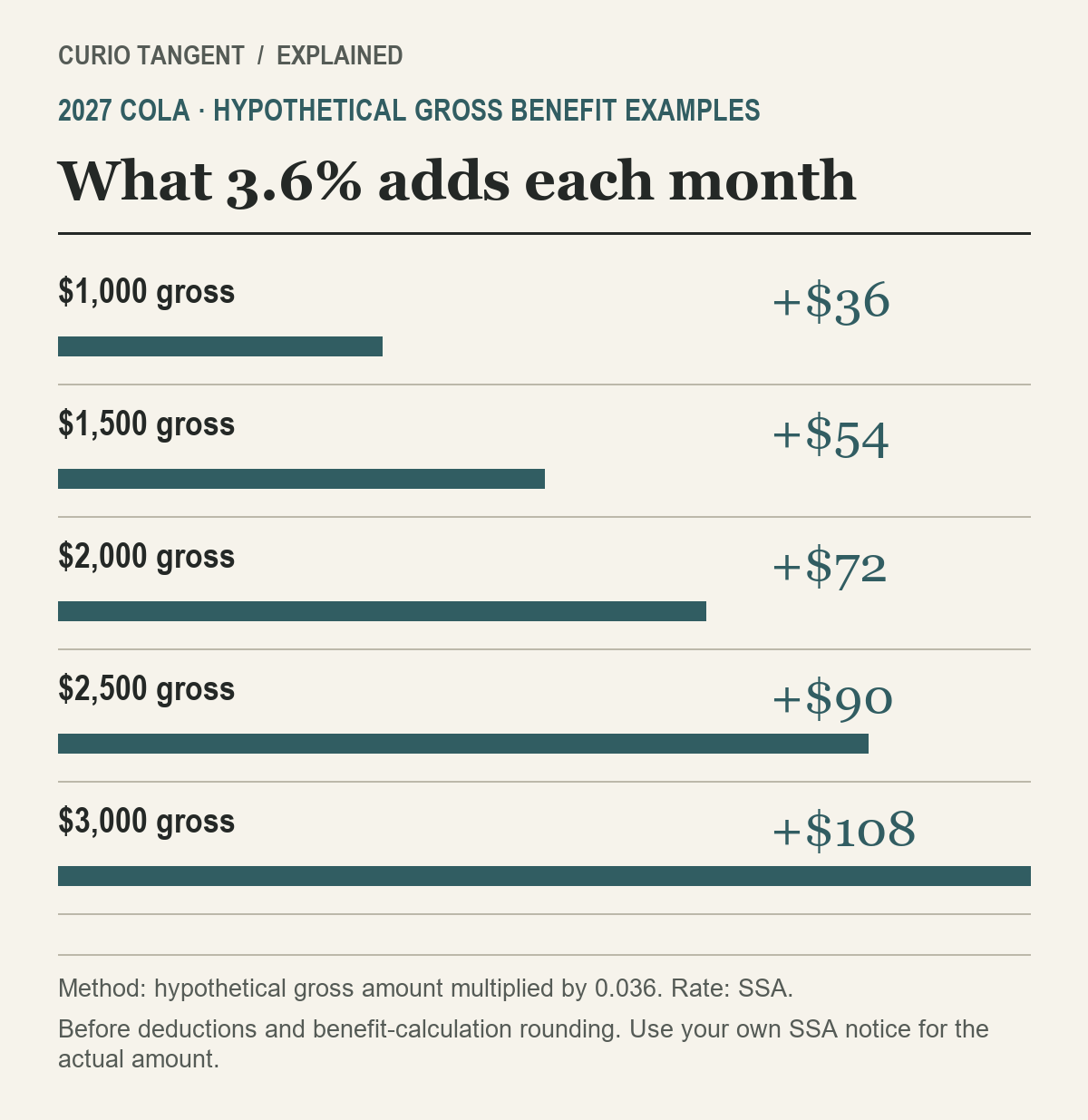
A $2,000 gross example therefore adds $72 a month in simple arithmetic. Across 12 payments, that hypothetical difference is $864 before deductions. That annualized figure assumes the same illustrated difference in every payment; it is not a separate annual benefit or a promise about your account.
SSA’s fact sheet estimates the average retired-worker monthly benefit at $2,095 before the adjustment and $2,170 afterward. An average is a description of a group. It does not mean every retired worker receives a $75 increase, and it should not replace the gross amount shown on your own notice.

Why the bank deposit may increase differently
Use three lines when comparing the old and new notice: gross benefit, deductions and net payment. If a deduction changes, the difference between two deposits can differ from the change in the gross benefit. Medicare premiums are one reason to check those lines rather than assuming the deposit grows at the headline rate.
For example, this article’s $72 increase belongs to a hypothetical $2,000 gross benefit. It is not a calculation made from a $2,000 deposit after deductions. Using the wrong starting number creates an estimate that looks precise but answers a different question.
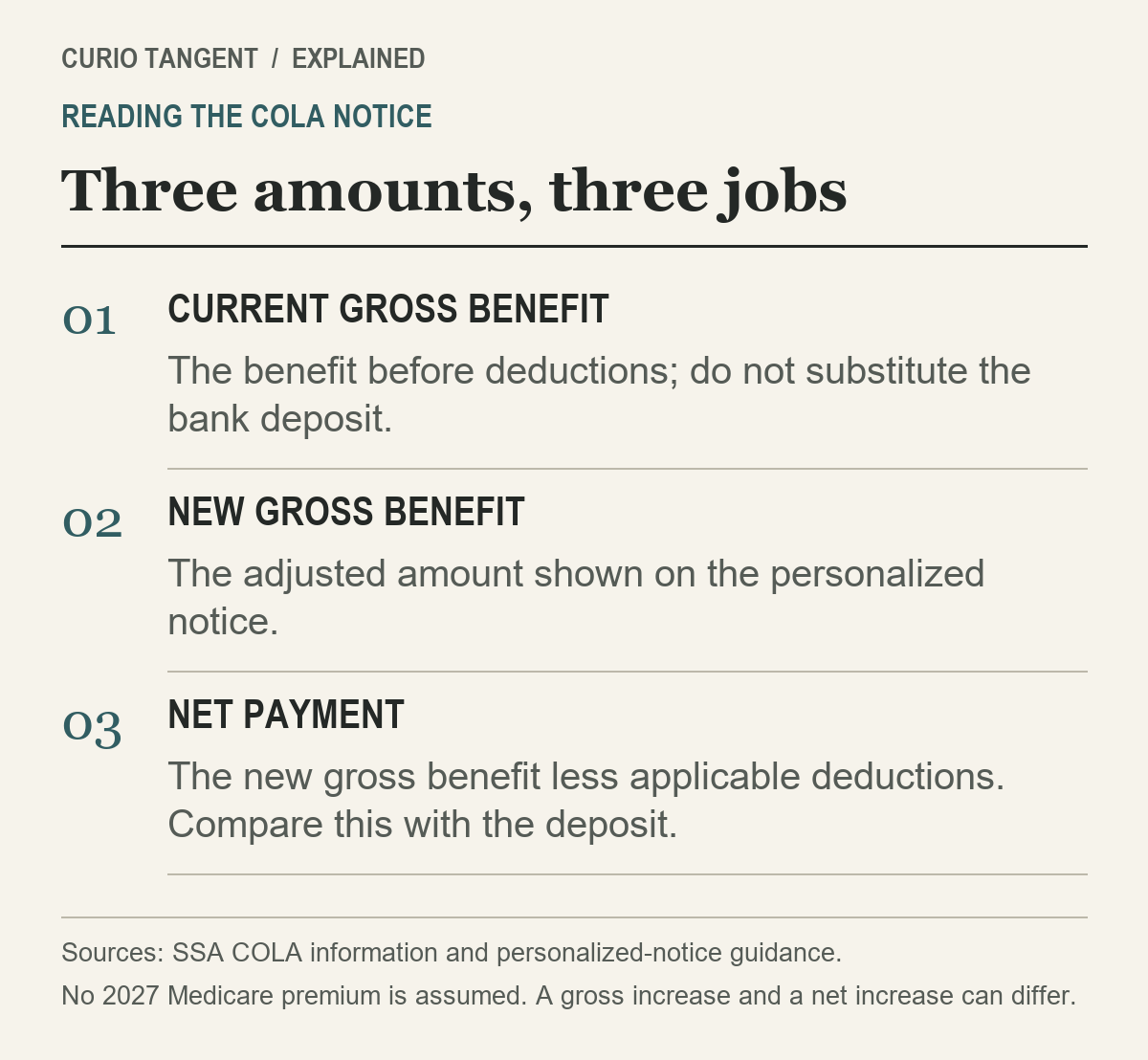
No 2027 Medicare premium is assumed in our examples. When the official amount and your notice are available, compare them directly. For a household spending plan, enter the actual net payment you expect to receive and keep the gross figure alongside it for reference.
The increase is automatic; an activation fee is a red flag
SSA’s Office of the Inspector General issued an October 21 scam warning. Beneficiaries do not have to register, apply or pay to activate the COLA. The warning describes impersonators offering to increase payments or activate the adjustment in exchange for money, personal information or changes to direct deposit.
Go to SSA through an address you enter yourself when checking a notice. A message that quotes the correct 3.6% figure is not, by itself, proof that its sender is legitimate. If a message asks for an unexpected payment or account change, verify it through an official channel before acting. SSA provides a reporting route at ssa.gov/scam.
A practical comparison before January
- Find the current notice and identify the gross benefit separately from the deposit.
- Use the 3.6% calculation only as a provisional illustration.
- When the personalized notice arrives, compare its gross amount, deductions and payment date.
- Update the household budget from the expected net payment, keeping a copy of the notice.
Recurring costs deserve the same attention as the income side. Our discovery+ price-change guide shows how a small monthly increase adds up across a year. For loan paperwork, our PSLF checklist explains why account-specific records matter more than a headline alone.
Sources and method
Checked October 25, 2026, for US federal benefits. The rate, dates and notice guidance come from SSA; the scam warning comes from SSA OIG. AP supplies a separate reporting cross-check. Dollar examples are Curio Tangent arithmetic using stated hypothetical gross amounts. Prepared with AI assistance and checked against the linked sources. This is general information; the personalized SSA notice determines an individual payment.