News & Trends / United States · AI agents
Claude Duet: Who Can Use Anthropic’s New Background Agent
Claude Duet is Anthropic’s new attempt to make an assistant useful between conversations. It can monitor connected work apps, prepare tasks on a cloud computer and ask for attention when something needs a decision. Access is still a limited research preview.

Anthropic announced the preview on October 21, 2026, then published a fuller safety and privacy explanation on October 23. The practical questions are more specific than whether an AI can “work for you”: who can get in, what runs while you are away, and which actions still wait for approval?
Claude Duet starts with a waitlist
The launch announcement says the preview begins with US Pro and Max subscribers. It is available through a separate app on iOS and Android and on claude.ai. Joining the waitlist is not an immediate promise of access.
Anthropic describes a morning brief and periodic checks of connected apps. Tasks run on a virtual machine with its own browser, so the user’s laptop or phone does not need to remain on. The company says Duet can notify the user when work is done or a decision is needed. These are the announced capabilities, not results from a hands-on test by Curio Tangent.
The distinction between an occasional chat and a background agent is about timing and access. A chat starts with a question. An agent can revisit connected information and continue a task after the screen is closed. That makes the scope of the connection part of the product, not merely a setup detail.
Background work still uses the subscription’s limits
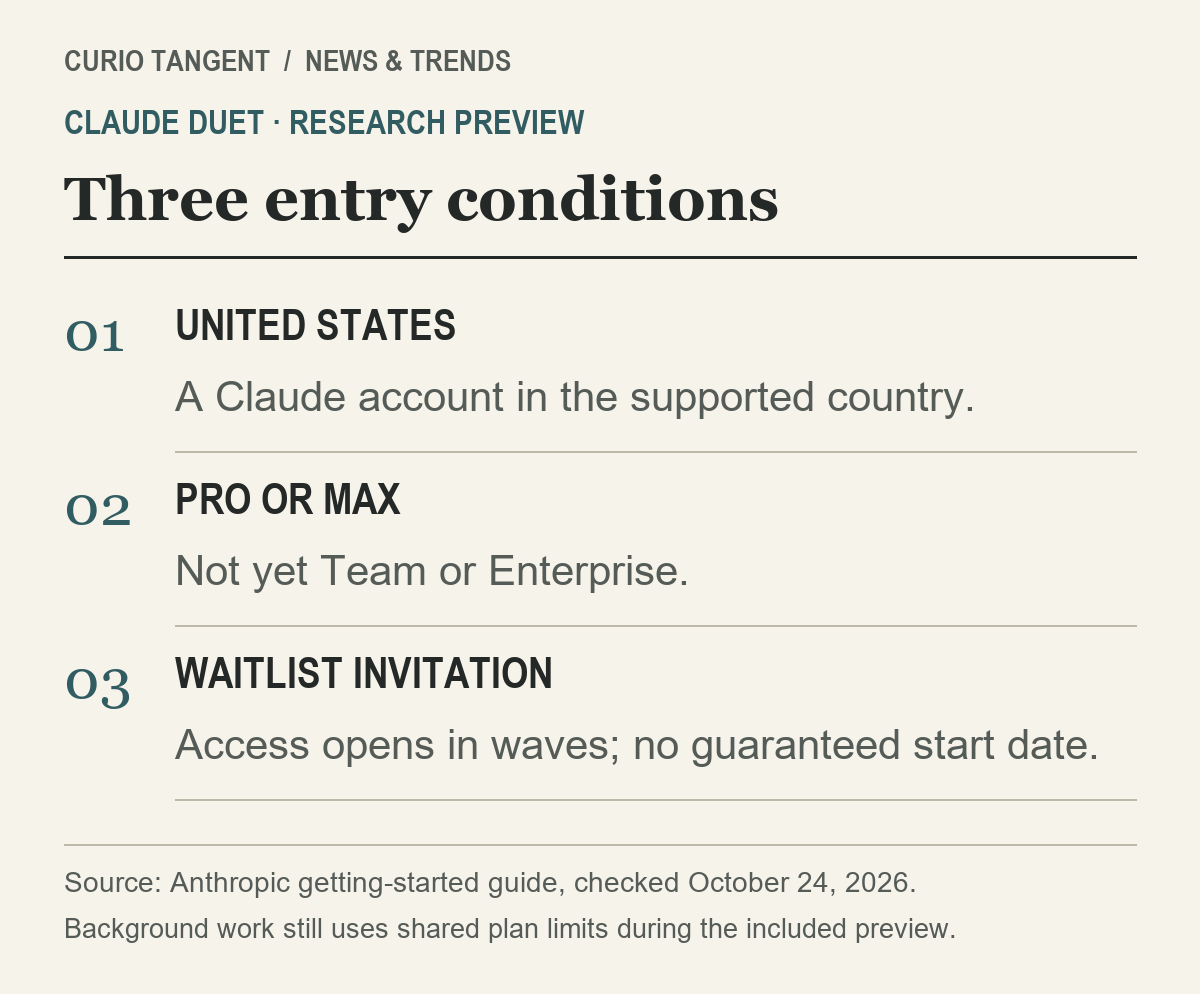
According to the getting-started guide, access requires a US account, a Pro or Max plan and a waitlist invitation. Team and Enterprise plans are not included yet. During the preview there is no additional Duet charge, but its work shares the plan’s five-hour and weekly usage limits.
Morning briefs, background checks and larger tasks all count. “Included” therefore describes pricing, not unlimited work. The guide also says checks occur at intervals, so a genuinely urgent message can arrive between them. An always-available cloud computer should not be confused with a guarantee of instant monitoring.
| Question | Current preview answer |
|---|---|
| Can any subscriber start immediately? | No; invitations open in waves. |
| Must the phone stay on? | No; work runs in the cloud. |
| Is background work free of usage limits? | No; it uses the plan’s shared limits. |
| Can a user watch or take over its browser? | Not in the current preview. |
The guide lists other limits, including unavailable Microsoft 365 support and restrictions on some connectors. Those details can change during a preview, so a particular work app should be checked before treating Duet as a replacement for an existing process.
Where the agent is supposed to pause
Anthropic’s October 23 safety explanation says important actions are presented for approval. It describes a separate action check and a sensitive-information check. Some actions, including securities trading and moving money between bank accounts, remain off-limits even with approval.
The company also distinguishes stopping future access from erasing remembered information. Connected-app choices carry across Claude and Duet; switching an app off stops new access, but information already learned remains until the relevant memory is reset. That is worth reading before connecting an account containing other people’s information.
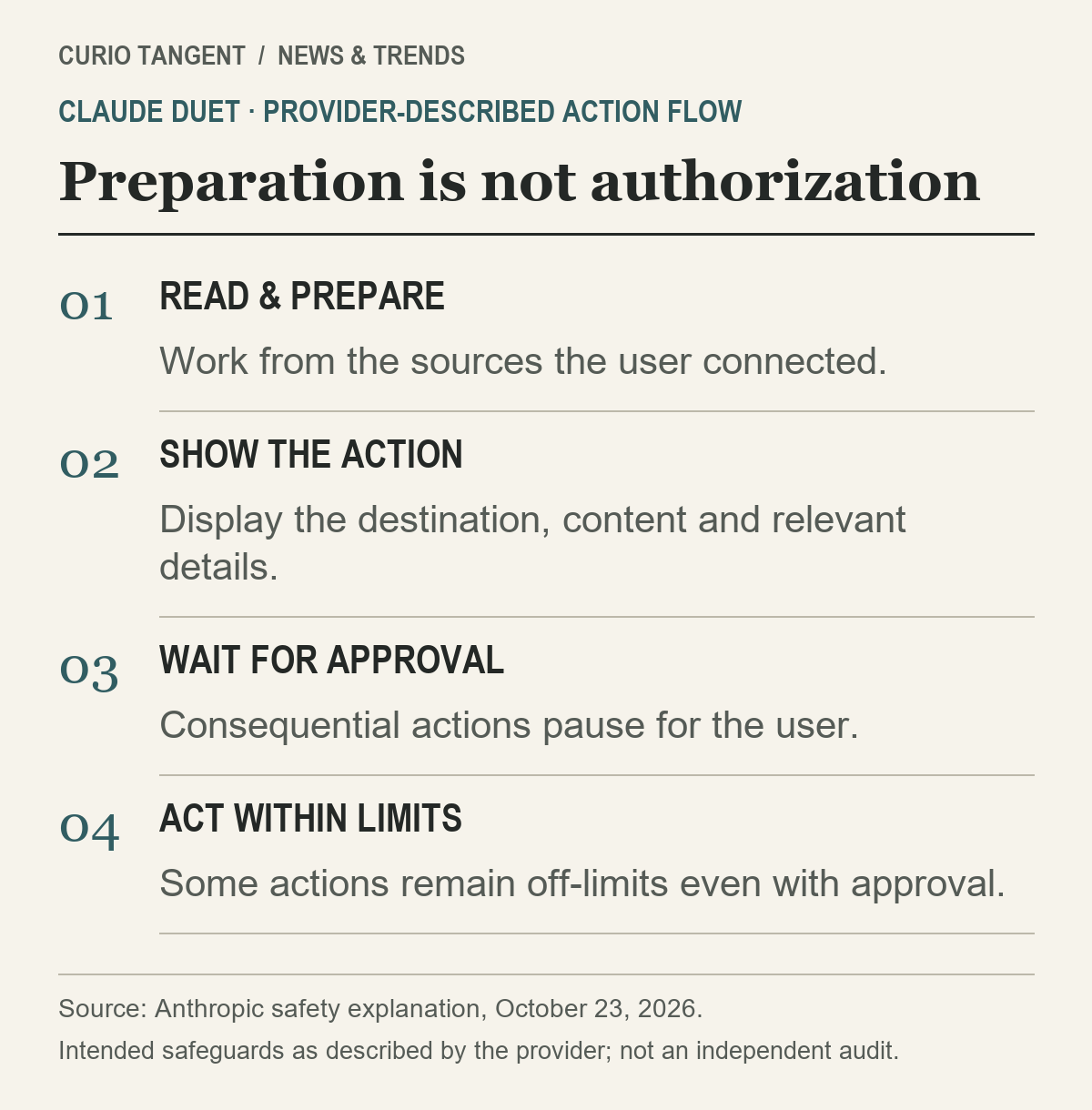
These are the provider’s descriptions of its safeguards. They do not establish that every attempted action will be classified correctly. An approval screen is useful only if the recipient, destination, content and amount are checked against the user’s intention.
Preparing a purchase is different from authorizing one
Stripe’s partnership announcement describes Duet’s connection to Stripe products and its Link purchasing flow. In that arrangement, a proposed purchase goes to the user for confirmation, and a constrained payment credential is issued for the approved transaction. This is a partner’s description of the payment mechanism, not a recommendation to buy through it.
The distinction is practical. Asking an assistant to find a replacement office item does not answer whether it picked the right merchant, quantity, delivery address or total. Those details belong in the approval, even if the preparatory research happened in the background. An agent can save time assembling a decision without making the decision inconsequential.
A small trial needs a clear finish line
For an invited user, a useful evaluation would be a contained task with an output that can be checked: assemble a meeting brief from specified messages, list unresolved questions and draft a reply. State which sources it may use, what a finished brief must contain and which steps need review. This is a proposed evaluation method, not work we performed with Duet.
Judge the result by whether the cited email or file supports each important claim. A polished summary can still omit a constraint, and a draft can still address the wrong person. Track whether the background checks provide useful signals and whether the shared usage budget leaves room for other Claude work. No benchmark or productivity saving is assumed here.
Connected-account questions are also central to our Google privacy policy explainer. For checking the output itself, see how to fact-check an AI answer.
For the subscription decision, our Claude Pro vs Max comparison separates the payment due, shared usage limits and the two credit systems.
Sources and method
Availability and limitations come from Anthropic’s announcement and help center, checked October 24, 2026. Safeguards are attributed to Anthropic; the payment description is attributed to Stripe. We did not obtain preview access, conduct a security audit or test the product.
Prepared with AI assistance; product descriptions were checked against the linked material.