News & Trends / United States · Subscription bills
discovery+ Price Increase 2026: When Your Bill Changes
The discovery+ price increase puts US monthly plans at $6.99 with ads and $11.99 ad-free, before tax. New subscriptions have used those prices since October 13. For existing subscribers, the key date is the first renewal on or after November 12, 2026—not necessarily November 12 itself.
The change is confirmed in the service’s US price notice. Promotional periods and subscriptions sold through other providers need a separate check. Start with your renewal date and the company collecting the payment, then work out the effect on your own budget.
What the discovery+ price increase costs
| US monthly plan | Previous price | New price | Extra across 12 payments |
|---|---|---|---|
| With ads | $5.99 | $6.99 | $12.00 |
| Ad-free | $9.99 | $11.99 | $24.00 |
All figures exclude tax. The last column multiplies the monthly difference by 12; it does not describe an annual subscription sold by discovery+.
At the new monthly rate, 12 payments would total $83.88 with ads or $143.88 ad-free, compared with $71.88 or $119.88 at the previous prices. A household comparing subscriptions should use the full dollar total as well as the monthly figure. A one-dollar increase is easy to overlook when several services renew on different days.
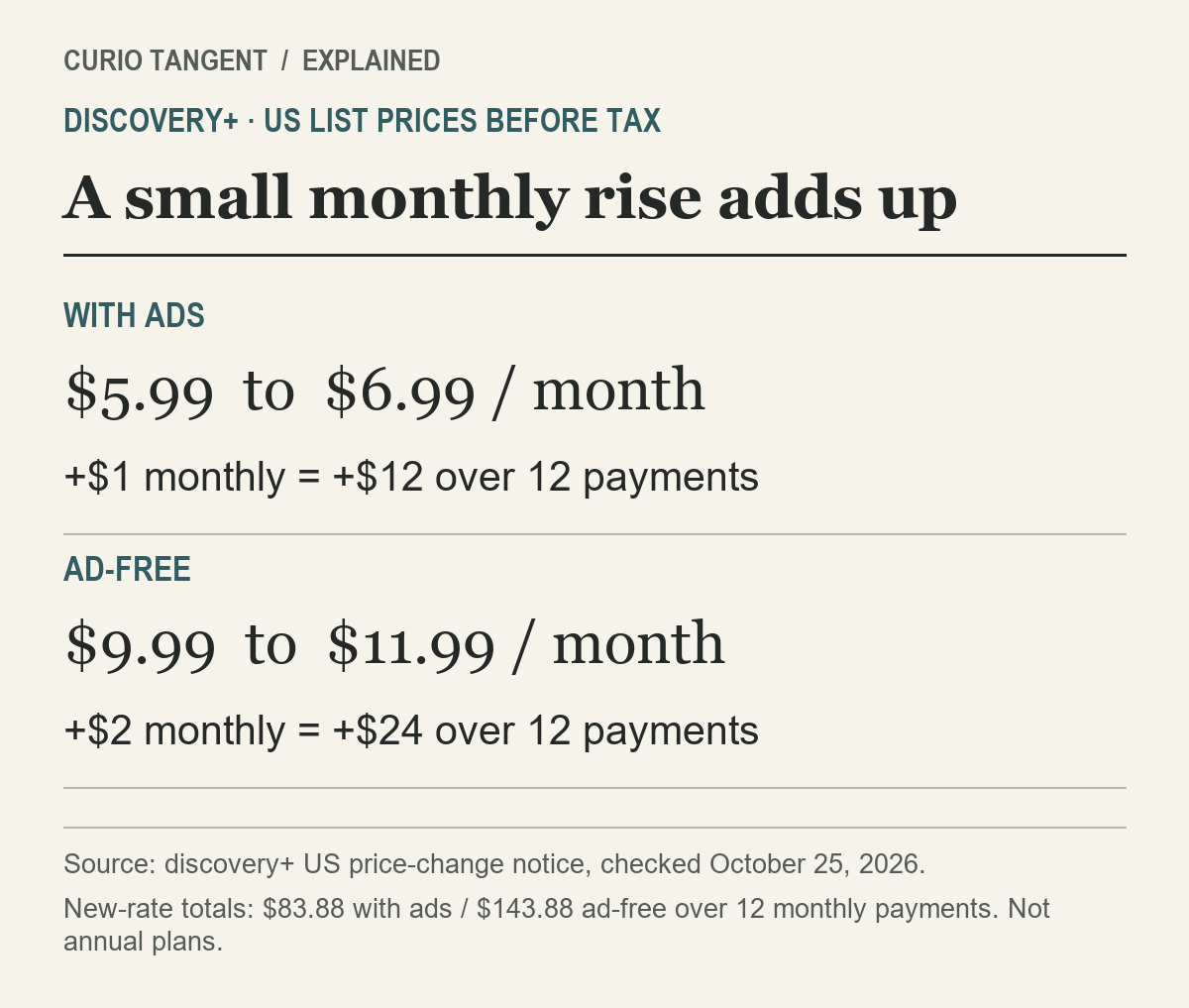
Ad-free now costs $5 more per month than the ad-supported plan. That is $60 over 12 payments, if both prices stay unchanged. Whether avoiding ads is worth that difference depends on how often you watch and how much interruptions bother you. This calculation gives a comparison; it does not establish the value of the catalog for your household.
November 12 is a threshold, not everyone’s billing day
The announced rule applies to the first eligible renewal. Consider these illustrations for an ordinary monthly cycle, without a promotion:
| Your monthly renewal | First renewal at or after the threshold |
|---|---|
| November 11, then December 11 | December 11 |
| November 12 | November 12 |
| November 20 | November 20 |
The first row is a calendar example: November 11 comes before November 12. It assumes the same day-of-month billing pattern continues. Your actual account notice remains the place to confirm the amount and date, particularly after a plan change or a billing adjustment.

For direct and app-store billing, the notice says renewal happens automatically at the higher rate. An active promotional discount continues until the promotion ends. If a separate provider sells your subscription, use that provider’s applicable price notification instead of assuming these examples settle its terms.
Find the bill before changing the subscription
In discovery+, open your profile, then Account and the Subscription area to identify the biller. Check the corresponding receipt or account page for the next payment. The price notice links to billing guidance for Apple, Google Play, Amazon, Roku and Samsung, as well as direct subscribers.
Write down three items together: the plan name, the renewal date and the company charging you. That small record prevents a common budgeting error: comparing one subscription’s advertised price with another subscription’s actual tax-inclusive charge. Use the same basis for both.
A streaming box or remote does not reveal the billing arrangement. The same TV setup can be used with accounts bought through different channels. Follow the payment record rather than guessing from the hardware beside the screen.
Keep, change or cancel: a short decision check
Before the renewal, review what you actually watched during the previous month. If a particular show is the reason to stay, check its current availability in your region directly in the service. This article does not independently verify the catalog or promise that a title will remain available.
Then compare the next charge with the value you expect during that billing period. A service you use each week deserves a different assessment from one you opened once. Avoid counting a hoped-for discount in the budget until the offer and its conditions appear in your account.
If you choose to leave, discovery+ has a separate cancellation guide. It advises cancelling a day before the next billing date to avoid further charges and says deleting the app does not cancel billing. For a directly billed subscription, use the cancellation control in the Subscription area; third-party customers must follow their biller’s route.
Keep the confirmation and check the stated access end date. Direct subscriptions ordinarily remain usable through the paid period, but provider terms can differ: discovery+ specifically notes immediate access loss for DIRECTV cancellation. Do not assume one cancellation route applies to every seller.
For another recurring-bill comparison, see our Claude Pro vs Max cost guide. The same budgeting habit applies: separate the amount charged, the period it covers and any optional extra spending.
Sources and method
Checked October 25, 2026, for US subscriptions. Dates and plan changes come from discovery+’s price notice; cancellation guidance comes from its separate help article. Cost totals and renewal examples are Curio Tangent calculations using the stated assumptions. Photographs show illustrative hardware, not a discovery+ interface. Prepared with AI assistance and source checks; no private customer account or catalog test was performed. This is general subscription information, not individual financial advice.