Money / United States · Student loans
PSLF Appeal Dropped: What Student Loan Borrowers Should Check
The government’s retreat from a court fight over PSLF employer restrictions leaves an important protection in place for public-service workers. It does not erase the paperwork or automatically cancel a borrower’s balance.
On October 22, 2026, the parties filed a joint stipulation to dismiss the government’s appeal in the states’ challenge to a rule narrowing Public Service Loan Forgiveness eligibility. For someone working toward forgiveness, the immediate task is to separate that legal development from the loan, employer and payment records in their own account.

The PSLF appeal concerned an employer rule
The disputed regulation would have allowed the Education Department to exclude government and nonprofit employers it determined had a substantial illegal purpose. The Government Accountability Office’s review of the October 2025 final rule explains the exclusion mechanism and the department’s stated aim of preventing improper use of taxpayer funds. That review describes the challenged policy, not a rule borrowers should now treat as operative.
A federal district court vacated the rule on June 30, 2026. California’s attorney general, a participant in the states’ lawsuit, announced the appeal’s withdrawal on October 22. The accompanying First Circuit filing in case 26-1973 is dated October 22 and stipulates dismissal, with each side bearing its own fees and costs.
There were parallel challenges. The National Council of Nonprofits announced the withdrawal of the appeal in its coalition’s case on October 22, following a Wednesday filing. That explains why reports can refer to more than one appeal and different filing dates. The date used here for the states’ case comes from its actual filing.

What the development means for a borrower
The withdrawal leaves the district court’s ruling against the employer restriction in place. That removes this particular attempt to narrow the employer definition through the challenged rule. It does not create a new general-purpose debt cancellation program or change every separate federal student-loan policy.
PSLF remains a program for borrowers who meet its requirements. The CFPB’s overview describes forgiveness of eligible federal Direct Loans after 120 qualifying monthly payments while working for an eligible public-service employer, under a qualifying repayment plan. Those conditions still have to be documented. Private student loans are outside this federal program.
The distinction matters when reading a celebratory headline. Winning an employer-eligibility dispute and having an individual forgiveness application approved are different events. An account showing fewer than 120 qualifying payments does not turn into a completed application because an appeal ends.
Four records worth checking
Start with the loan type. Federal Student Aid’s PSLF beginner guide says only nondefaulted Direct Loans qualify directly. FFEL and Perkins loans do not qualify unless consolidated into a Direct Loan. Consolidation can have consequences, so confirm the current rules for the particular loans before making a change.
Then check the employer. Eligibility generally depends on the employing organization rather than the job title. Federal Student Aid specifies an average of at least 30 hours a week for a qualifying employer. Its employer search uses the organization’s Employer Identification Number, usually found in box b of a W-2. A familiar workplace name alone may not identify the actual payroll employer.
Next, inspect the qualifying-payment count and the employment periods behind it. Keep a copy of the account’s current count and supporting records. Finally, check the repayment plan and status against current Federal Student Aid guidance. This appeal does not settle questions about every repayment plan, a deferment or a forbearance period.
| Record | Question to resolve |
|---|---|
| Loan details | Is the loan a qualifying Direct Loan? |
| Employer and dates | Is the organization eligible for the period claimed? |
| Payment history | Which months are recorded as qualifying? |
| Plan and status | Do the applicable repayment rules support those months? |
Why 120 payments is a record of qualifying months
PSLF is not simply a target dollar amount. It tracks qualifying monthly payments and employment. Federal Student Aid says those payments do not have to be consecutive. A break in qualifying employment therefore does not, by itself, wipe out earlier qualifying credit.
Here is an illustration, not an actual borrower record. A person with 96 qualifying payments has 24 more qualifying monthly payments to reach 120. That is two years only if every subsequent month qualifies and is credited. It is not a promise that processing will finish on a particular date.
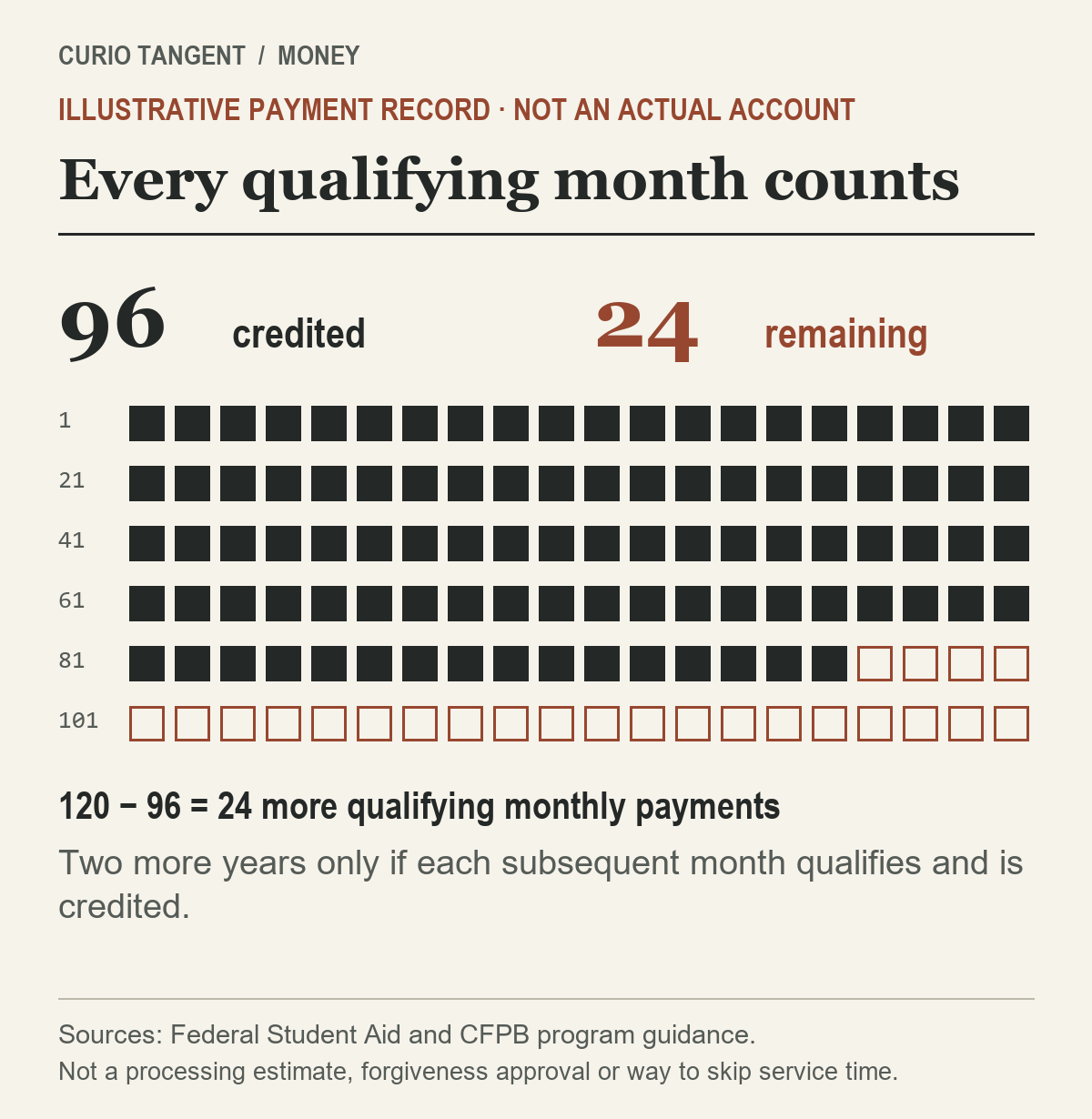
The arithmetic is deliberately simple: 120 minus 96 equals 24. The administrative question is harder: does each claimed month meet the rules, and is it reflected correctly? Paying extra does not let someone skip the required employment period. Any permitted prepayment treatment still has conditions.
Keep certification separate from the news cycle
Federal Student Aid’s employer guidance explains that the PSLF form records employment information and requires certification by an authorized employer representative. Its Help Tool can generate the form and support electronic signatures. Missing or inconsistent information can leave a form incomplete.
Submitting updated employment certification annually or after an employer change helps keep a usable record. Save the submitted form, the signature confirmation and the resulting count. If something appears missing, identify the particular employment period or month rather than assuming the court development will correct it automatically.
For a practical way to check confident online claims, including AI summaries of loan news, see our five-step fact-checking guide. For an individual account decision, use current Federal Student Aid instructions and the relevant account records.
Sources and method
Legal dates were checked against the states’ dismissal filing and the linked announcements. Eligibility explanations use CFPB and Federal Student Aid materials; the 96-payment example is invented solely to show the arithmetic. Checked October 24, 2026. No account was accessed and no individual eligibility determination was made.
Prepared with AI assistance; sources and calculations were checked against the linked material. No independent human legal or financial review is claimed.