Money / United States · Housing policy
Mortgage Executive Order: What Could Change for Borrowers
The new mortgage executive order targets several costs around a home loan: mortgage insurance, refinancing paperwork and certain government direct-loan rates. For borrowers, the useful question is which line on their bill could change—and when.
President Donald Trump signed the order on October 22, 2026. It gives housing agencies instructions, rather than giving every homeowner a new interest rate. Some measures depend on agency decisions, eligibility rules and implementation. Here is how to read the announcement without mistaking a policy direction for a personalized offer.

What the mortgage executive order actually directs
The White House order has three provisions particularly relevant to borrowers. First, it calls for a conditional Fannie Mae and Freddie Mac pilot to identify mortgages eligible for proactive mortgage-insurance cancellation using current property values. Crucially, that pilot would cover only mortgages made after the pilot is established.
Second, it directs a conditional expansion of title-acceptance arrangements for eligible refinances. Approved automated title review could replace a lender’s title-insurance policy; resulting savings must reach borrowers. Third, it tells USDA and VA to reduce rates on single-family loans made directly by those departments, subject to law and available funding. That wording does not cover every privately originated loan carrying a government guarantee.
The order also creates a manufactured-housing task force, with recommendations due within 180 days. That is a separate effort to address housing production, rather than an immediate reduction in an existing mortgage payment.

Mortgage insurance already has cancellation rules
Private mortgage insurance, or PMI, is a recurring cost that protects the lender. It is different from homeowners insurance, which covers risks to the property. Removing PMI can reduce a payment without changing the mortgage’s interest rate.
Existing protections matter. For many covered conventional mortgages, borrowers can request cancellation when the balance reaches 80% of the home’s original value, subject to payment history and other conditions. In general, automatic termination is due when the scheduled balance reaches 78%, provided payments are current. The Consumer Financial Protection Bureau explains the conditions and exceptions, including different rules for FHA, VA and lender-paid insurance.
The proposed pilot concerns a different route: proactive reviews that consider current market value. A house-price increase is therefore relevant to the proposed mechanism, but an online valuation alone is not a cancellation approval. An existing borrower should ask the servicer which cancellation rules already apply to the loan.
A title-policy saving is a closing-cost saving
Refinancing replaces a mortgage with a new loan. One potential expense is the lender’s title policy, which protects the lender against specified title problems. It is separate from an owner’s policy.
The FHFA’s explanation of the original title-acceptance pilot, published in March 2024, describes waiving the lender-policy or legal-opinion requirement on certain low-risk refinances. The new order seeks to expand that approach. Neither document makes every refinance eligible or promises to remove every closing charge.
That distinction is easy to lose in a headline. A smaller one-time bill changes the cost of switching loans. A lower interest rate changes the stream of interest payments. Both can matter, but they are different entries in the calculation.
A worked example: how an upfront saving changes break-even
Consider a hypothetical refinance that saves $150 a month on principal and interest. Suppose the relevant upfront cost is $3,600. Dividing $3,600 by $150 gives a simple cash-flow break-even of 24 months.
If the same loan instead costs $2,400 upfront, the calculation is $2,400 divided by $150: 16 months. The assumed $1,200 cost reduction brings that simple break-even forward by eight months. These numbers illustrate the mechanism; they are not an advertised saving under the order.
| Hypothetical offer | Upfront cost | Simple break-even |
|---|---|---|
| Offer A: $150 monthly saving | $3,600 | 24 months |
| Offer B: $150 monthly saving | $2,400 | 16 months |
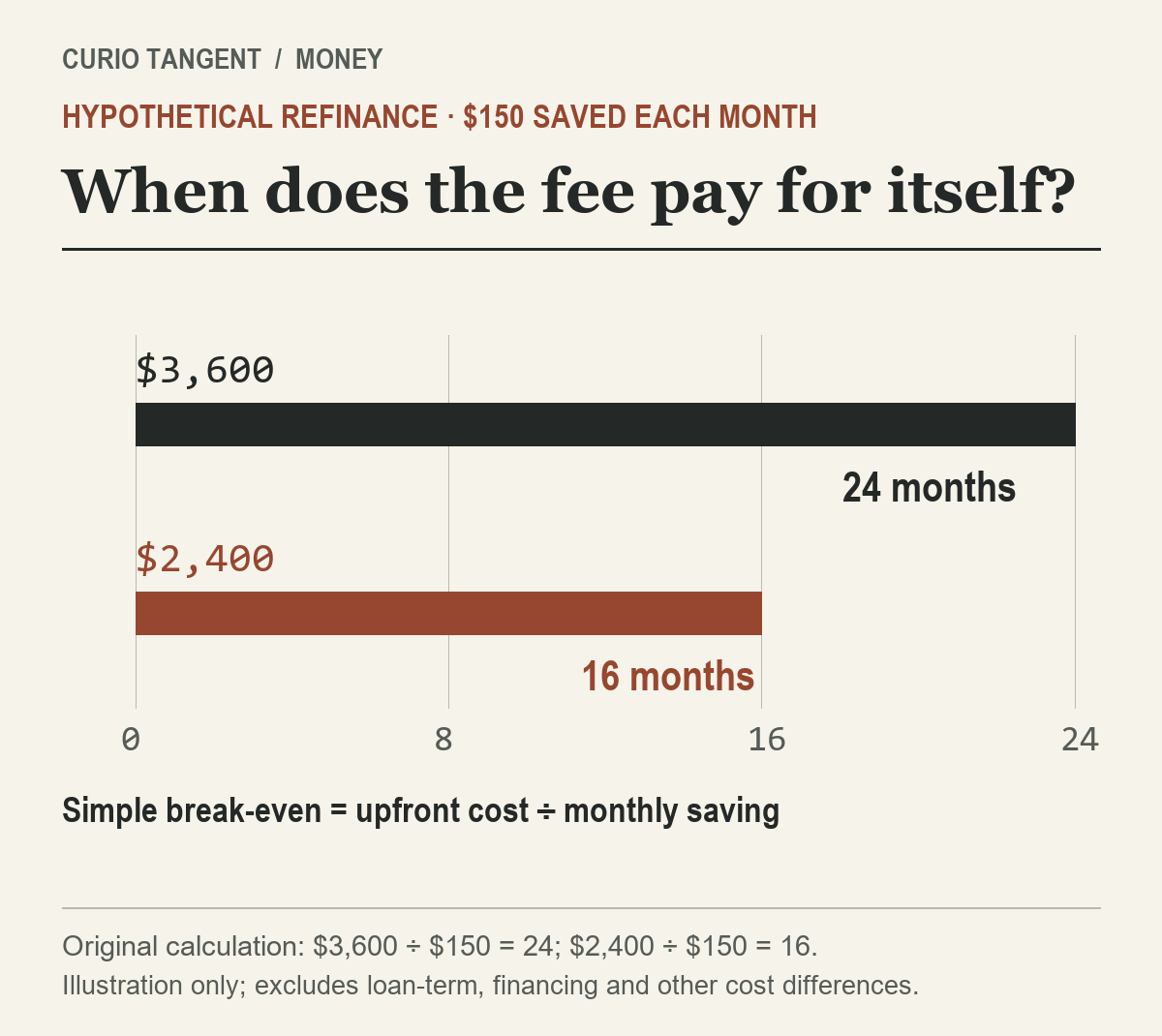
The calculation assumes constant savings, costs paid upfront and no difference in other expenses. It leaves out financing costs, the time value of money, taxes, insurance and changes in equity. It is a screening tool, not a total-cost comparison.
The CFPB’s refinancing guide explains why a lower monthly payment can still produce a higher lifetime cost if repayment stretches over more years. Property taxes and homeowners insurance may also stay the same. Compare the remaining term on the current loan with the proposed term, not just this month’s payment.
What to put next to the headline
For a cancellation question, gather the mortgage statement, PMI disclosure and payment history. Ask the servicer whether the answer comes from existing cancellation rules or a newly implemented program. For a refinance, compare written Loan Estimates with the same loan amount and term; identify which costs actually change.
Useful follow-up questions are specific: Is this loan eligible? Has the agency implemented the provision? Is the quoted reduction a one-time fee saving or a monthly saving? Does the offer extend repayment? A date and a written explanation are more useful than a broad promise of cheaper mortgages.
Readers comparing purchase costs across markets can also see our stamp duty guide for England and Northern Ireland. The taxes and mortgage rules are different, but separating upfront costs from recurring payments helps in both cases.
Sources and method
The linked executive order establishes the policy instructions; CFPB and FHFA materials explain the existing mechanisms. The two-offer comparison is Curio Tangent’s own arithmetic using explicitly hypothetical inputs. Policy status was checked October 24, 2026. This article explains the announcement and does not assess an individual borrower’s eligibility or recommend a loan.
Prepared with AI assistance; sources and calculations were checked against the linked material. No independent human financial review is claimed.