Artemis III Update: NASA’s Earth-Orbit Test Before the Moon
An explainer by Curio Tangent · Checked October 24, 2026
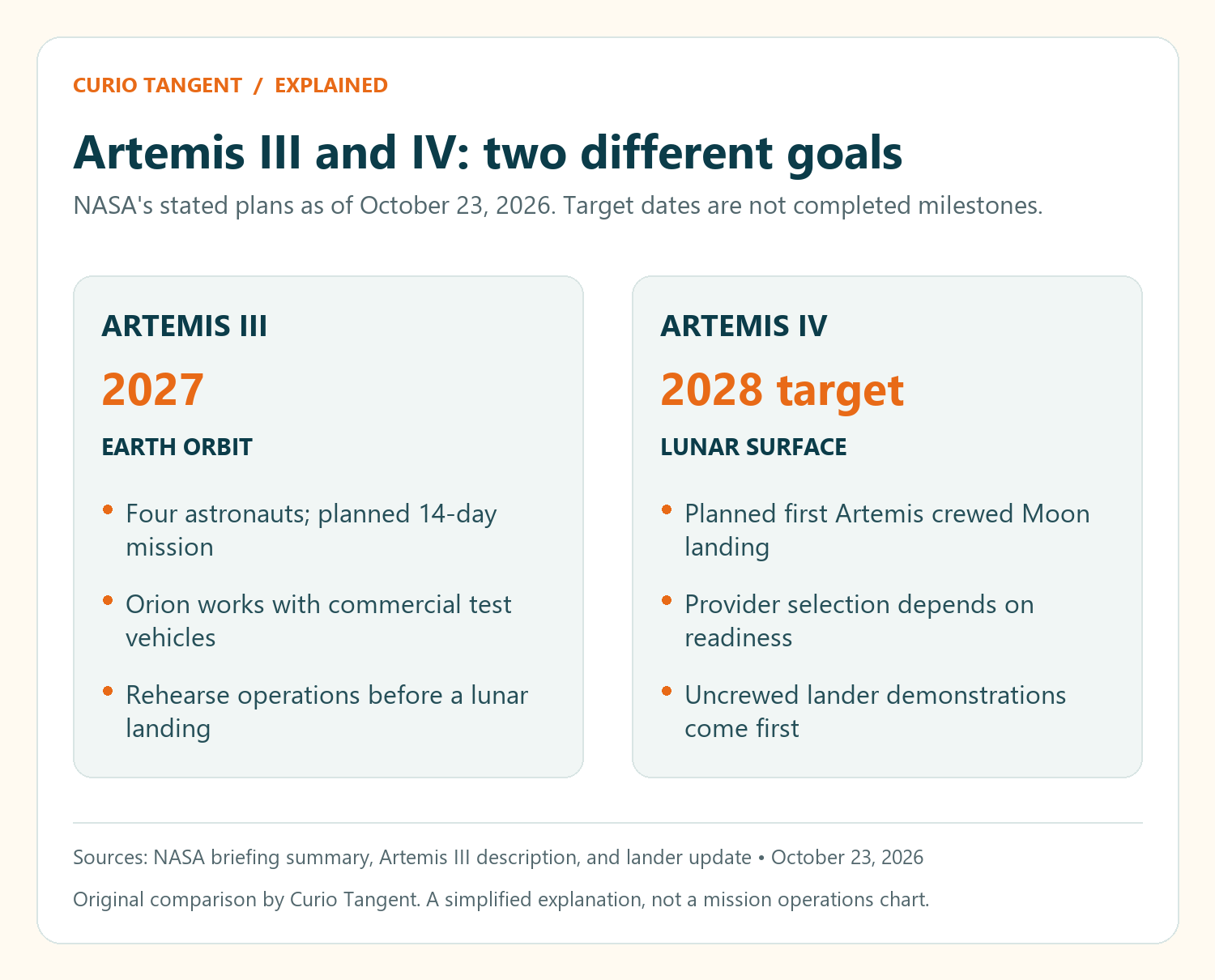
NASA’s next Artemis crew will rehearse close to Earth before astronauts attempt another lunar landing. In its October 23 update, the agency set out a 2027 Artemis III flight in low Earth orbit, followed by a targeted Artemis IV landing in 2028. The mission numbers matter: the upcoming third flight is a systems test, while the fourth is the planned return to the surface.
The latest Artemis III update makes more sense when you separate three questions: where the crew goes, which spacecraft must work together, and what has actually been demonstrated. A target date answers only the first part of the planning problem.
Artemis III update: what NASA announced on October 23
NASA’s briefing summary describes a path toward the 2028 surface mission and new details of the preceding Earth-orbit test. Its mission description calls for four astronauts on a planned 14-day flight, practicing operations with test vehicles from Blue Origin and SpaceX.
The Earth-orbit role itself is not a change first announced this week. NASA’s inspector general documented the revised campaign approach in March, following February’s changes. Friday’s material supplies a more detailed operating plan. That distinction matters if you encounter an older article that still describes Artemis III as the landing mission.
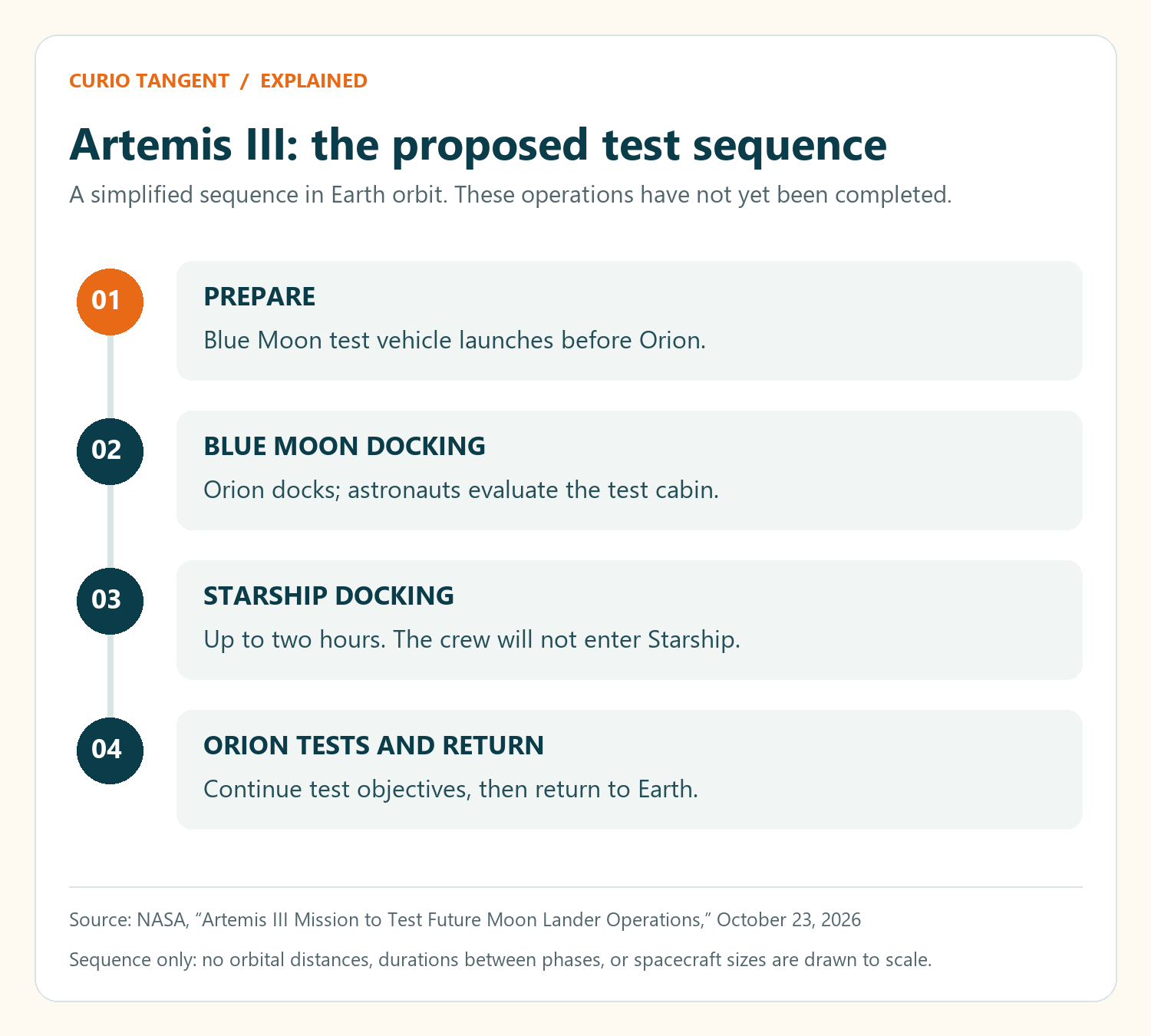
The proposed Artemis III sequence
The following is a simplified reading of NASA’s October mission description, not a flight schedule or a record of completed operations.
| Phase | Planned activity | What the test can establish |
|---|---|---|
| Prepare | Launch Blue Moon’s test vehicle before Orion | A vehicle ready for joint operations |
| First docking | Bring Orion together with Blue Moon; crew evaluates its cabin | How systems and people work across the two vehicles |
| Second docking | Dock Orion with a Starship test vehicle | Spacecraft interaction, communications, and control |
| Finish | Continue Orion objectives and return to Earth | Data for later mission planning |
NASA expects the Starship docking test to last up to two hours; astronauts will not enter Starship during that demonstration. The Blue Moon cabin evaluations and the Starship docking exercise therefore have different objectives. Treating them as identical tests would obscure what engineers expect to learn.
Why rehearse near Earth?
A mission can have capable individual spacecraft and still face difficult questions at their interfaces. The transition between vehicles brings together navigation, communications, software, docking hardware, procedures, and human decisions. NASA says Artemis III is intended to reduce risk before a crewed landing.
Consider the difference between two demonstrations. A spacecraft operating alone can show that its own systems function. A docking campaign asks whether separate vehicles and teams can carry out a shared operation. Watching that second result helps a reader understand progress more clearly than a launch count alone.
Earth-orbit results will not, by themselves, demonstrate a successful landing or ascent at the Moon. The useful question after Artemis III will be which objectives were completed, what data changed the plan, and which capabilities still need a separate demonstration.
The 2028 landing has two different development paths
In its separate lander-development update, NASA describes revised approaches from both companies. SpaceX’s plan retains transfers of cryogenic propellant in Earth orbit. Blue Origin’s accelerated approach instead uses transfer stages and defers propellant transfer. The proposed meeting orbits and travel arrangements also differ.
Both companies must perform uncrewed demonstrations before the near-term crewed landings. NASA says readiness will determine which provider is chosen for the first surface mission; neither is currently assigned to a particular Artemis landing flight under the realigned contracts.
That is a development strategy, not evidence that either complete mission has already worked. It gives readers several concrete milestones to follow: the relevant uncrewed flight, the required systems tests, NASA’s certification, and the eventual provider decision. Progress on one company’s route should not automatically be counted as progress on the other’s.
How to read the next headline
When another Artemis announcement appears, ask what kind of event it describes:
- A plan: an intended date, sequence, or vehicle choice.
- A completed demonstration: something that actually flew or was tested, with results to examine.
- A readiness decision: a judgment that the evidence is sufficient for the next operation.
These are different steps. A revised architecture may solve a planning problem while creating new work to validate the revised interfaces. A completed test may be valuable even when it reveals something that needs repair. Neither automatically settles the entire landing schedule.
The March inspector-general report described technical, integration, and schedule challenges. Its addendum also explained that the February campaign revision arrived after the audit work and that the office had not evaluated that revision’s full implications. It should be read as dated oversight, alongside the newer plan, rather than as a verdict on every detail announced in October.
For now, the clearest reading is that Artemis III is the Earth-orbit rehearsal and 2028 remains a landing target. Follow the demonstrated capabilities between those two points, not just the calendar. For another example of checking a space-related claim against original sources, see our five-step fact-checking guide.
Sources and reporting notes
- NASA’s October 23 briefing summary.
- NASA’s Artemis III operations description.
- NASA’s updated lunar-lander plans.
- NASA Office of Inspector General, March 10, 2026, including its campaign-revision addendum.
Checked October 24, 2026. This article was prepared with AI assistance from published documents; it does not claim attendance at the briefing or independent spacecraft testing. The diagrams are original Curio Tangent summaries of NASA’s stated plans and are not to scale. The fox illustration is AI-generated and conceptual. Plans and target dates may change as testing proceeds.