Life / Mind Glitches 02 · Familiarity and recall
Why Does Déjà Vu Happen? Familiarity Without a Clear Memory
Why does deja vu happen when you know a situation is new? One research approach separates the feeling of familiarity from the ability to retrieve a particular earlier experience. A place can produce a strong “I know this” signal while the memory that might explain that signal remains unavailable.
That is a useful clue, not a settled cause for every episode. This second Mind Glitches article follows experiments that manipulate virtual scenes, then asks what those experiments can—and cannot—tell us about the uncanny experience outside the laboratory.
Why does deja vu happen without a clear memory?
Consider an invented situation: you enter a café for the first time, yet the arrangement of the counter, seats and window feels familiar. You cannot name another café that explains the feeling. A later conversation might reveal a resemblance to somewhere you once visited, or it might not.
The example separates two questions. “Does this feel familiar?” asks about a judgment. “Which earlier place does it remind me of?” asks you to retrieve a source. A confident answer to the first is not automatically a successful answer to the second.
Colorado State University’s account of Anne Cleary’s research describes déjà vu in terms of familiarity when a situation seems as though it should not be familiar. The mismatch helps explain why an ordinary-looking room can feel so striking.
How spatial layout became a testable idea
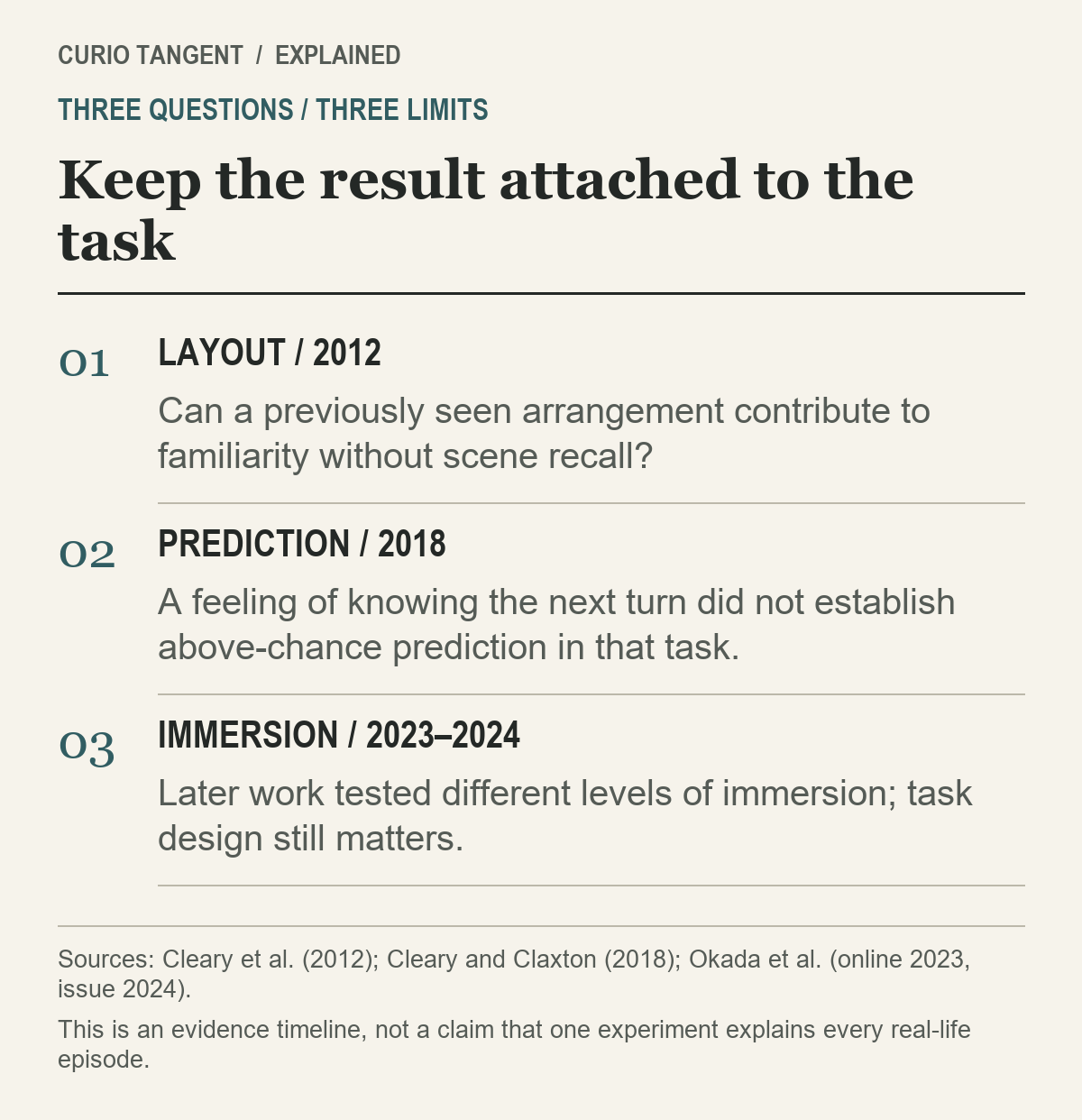
One hypothesis concerns the arrangement of a scene, rather than an exact match in all its details. Cleary and colleagues’ 2012 virtual-reality investigation tested familiarity associated with spatial configuration. Matching a previously encountered layout could increase déjà vu reports when participants did not recall the earlier scene.
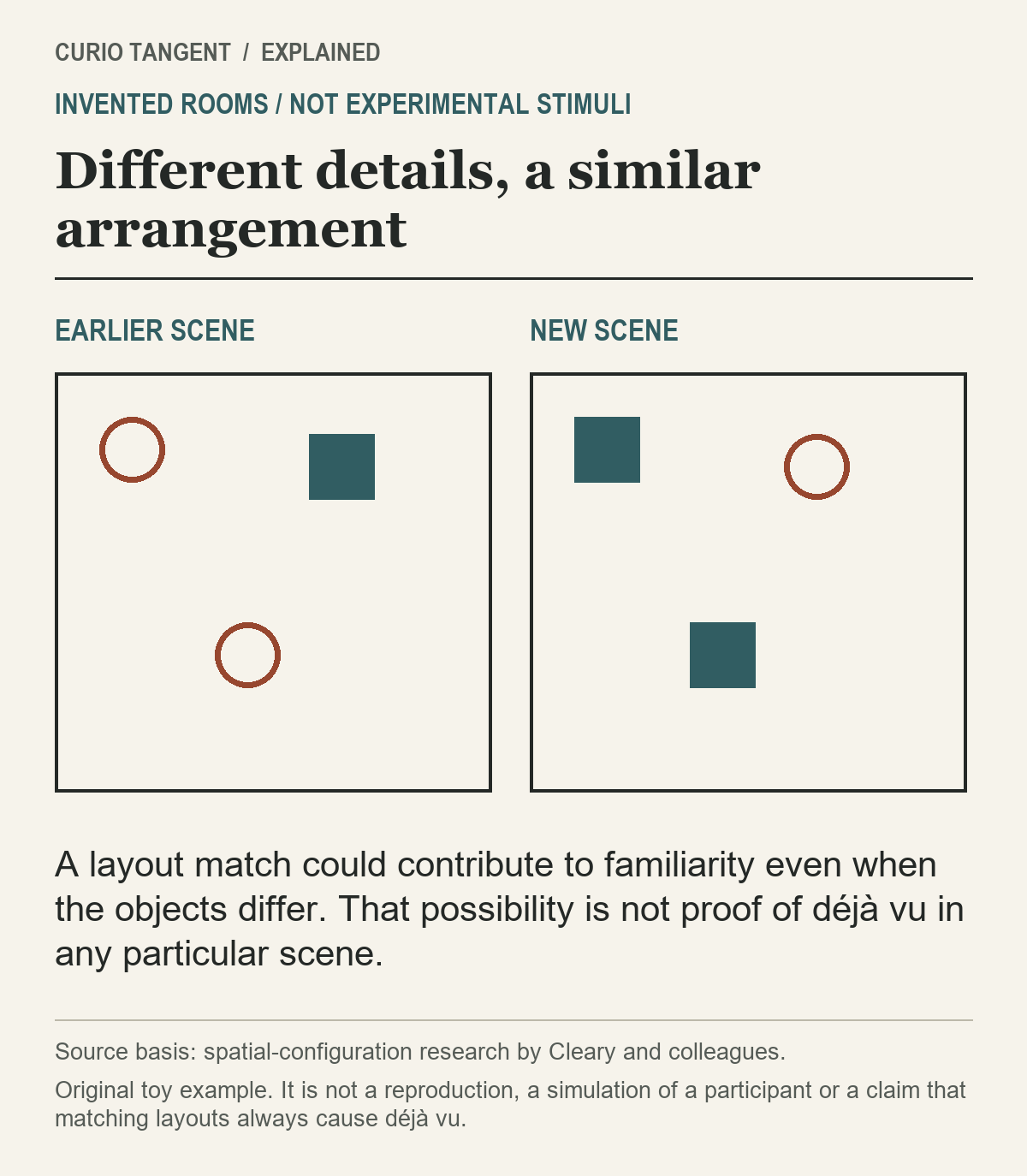
Our invented floor plans preserve positions while changing the symbols occupying them. They do not reproduce the researchers’ rooms. Their purpose is to make the comparison visible: “different things” and “different arrangement” are not the same manipulation.
This distinction also changes how to read a real-life anecdote. Recognizing a shared arrangement might suggest a possible source of familiarity. It would not prove that this was the source, or establish that every episode begins with a spatial match. An illustration can explain a hypothesis without confirming it for the person looking at it.
Feeling that you know the next turn
In a 2018 study, Cleary and Alexander Claxton used navigational paths through virtual scenes to investigate the feeling of prediction. Déjà vu was accompanied by stronger feelings of knowing which turn would come next, but it did not produce above-chance turn prediction in that task.
That is a distinction between a report about confidence and a scored answer. If the question is whether someone can predict left or right, the answer can be recorded before the turn occurs. Feeling certain and selecting the correct direction are then measured separately.
The result supports the possibility of an illusory feeling of prediction. It should not be inflated into a claim that researchers have explained every unusual memory experience. It also does not mean the feeling itself was fabricated: the experience and the explanation of it are different issues.
Later experiments make the story more nuanced
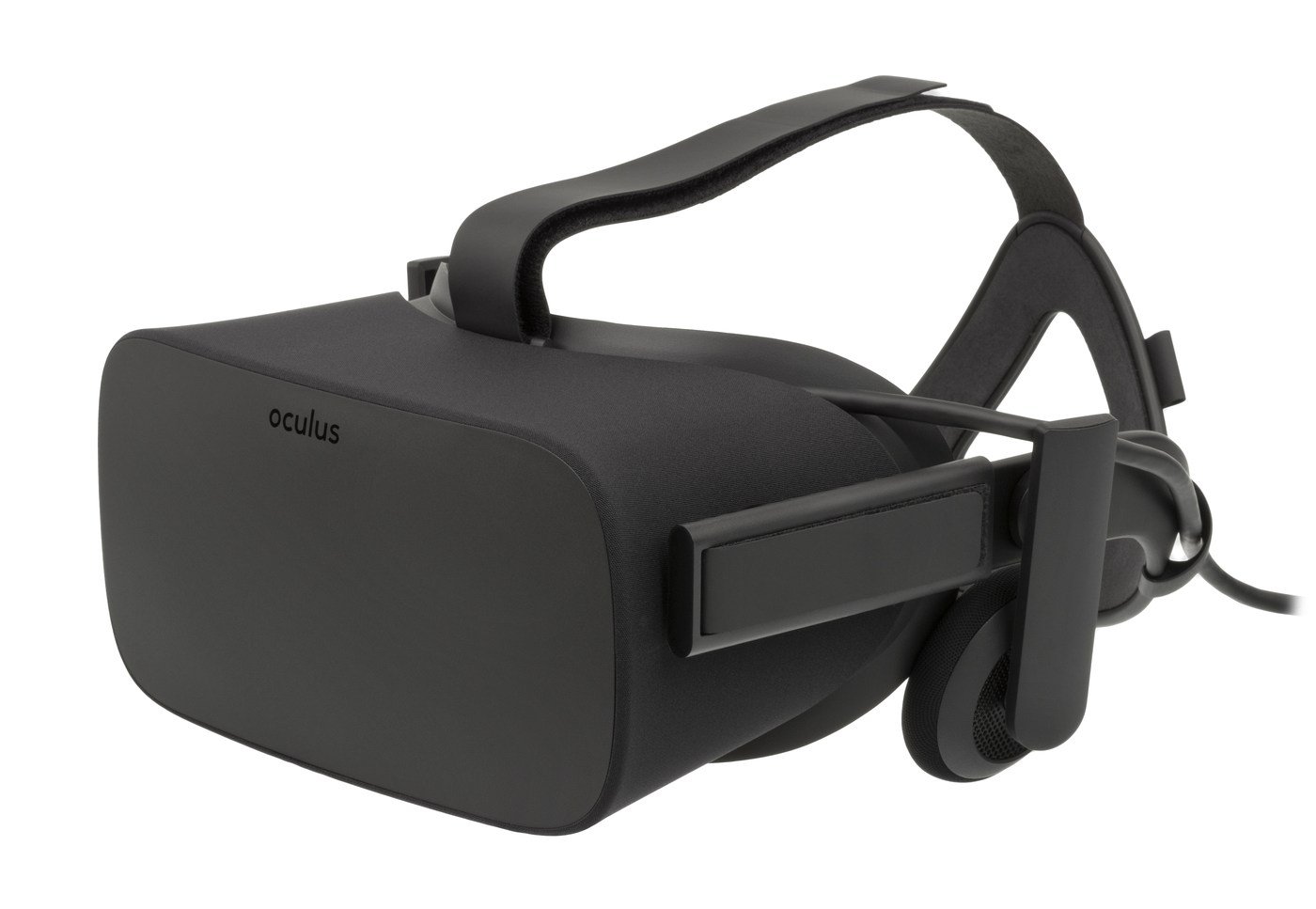
Okada and colleagues’ updated paradigm, published online in 2023 and in a 2024 journal issue, compared scene-memory tasks with different degrees of immersion. Spatial resemblance again mattered to familiarity and déjà vu reports.
The prediction findings were not identical across versions. In the more immersive experiment, prediction during recall failure was associated with déjà vu reports; the authors cautioned that this newly observed pattern needed replication. The overall recall-failure prediction score in that experiment was not significantly above chance.
There is no need to force those findings into a simple “prediction works” or “prediction never works” slogan. The studies involve previously encountered paths and memory-based information. The useful conclusion is that task design, comparison and replication matter. A feeling during a new real-life event is not, by itself, evidence of knowing an unexperienced future.
Three questions for any explanation you encounter
First, what was actually manipulated? Changing a scene’s layout is different from asking someone to describe a spontaneous episode after it happened.
Second, what was measured? A familiarity rating, a déjà vu report, recall of an earlier scene and a correct left-right prediction are different outcomes. An explanation that replaces all four with the single word “memory” loses useful detail.
Third, how far does the conclusion travel? A result from one controlled task can support a mechanism worth investigating. It does not automatically become the cause of every everyday experience that shares the same name.
The aphantasia article makes a similar distinction between reported experience and the methods used to study it. Next, the doorway effect shows why even a memorable experimental headline needs its conditions attached.
Sources and method
Checked October 26, 2026. This article distinguishes the cited study results, a university research account and our invented explanatory examples. Diagrams contain no measured participant data. Prepared with AI assistance and source verification. We did not induce déjà vu, test prediction or identify the cause of any reader’s experience.