Life / Mind Glitches 03 · Events and memory
The Doorway Effect: Why You Forget Why You Entered a Room
The doorway effect is a research finding associated with a familiar frustration: you enter another room and lose track of what you meant to do. Event-cognition researchers propose that a change of location can help mark a boundary between events, changing how readily information from the previous event is retrieved. It does not mean a door literally deletes a memory.

The distinction matters because the research is more conditional than the popular slogan. Some experiments found reduced access to recently handled objects after a room change. Other experiments did not find the same forgetting pattern. This third Mind Glitches article keeps both parts in view.
What the doorway effect experiments actually asked
The original task is more specific than “Why did I come into the kitchen?” In Radvansky and Copeland’s 2006 study, participants moved through virtual rooms and answered probes about objects they had recently carried or set down. A change of spatial region was associated with reduced accessibility of object information.
The everyday question concerns an intention—perhaps fetching a charger. The experiment concerns memory for objects within a designed task. Those questions are related enough to motivate an explanation, but they are not identical. An account that skips this difference can sound more conclusive than the evidence warrants.
| Question | What it concerns |
|---|---|
| What object did you just handle? | Memory for recently presented information |
| Did you see this object? | Recognition and the possibility of a false alarm |
| Why did you enter the room? | Retrieval of a current intention |
Why a boundary might matter
In an event-model explanation, a person represents the current situation together with its objects, actions and goals. A meaningful change can prompt updating that representation. Information connected with the previous situation may become harder to retrieve amid the new context and competing information.
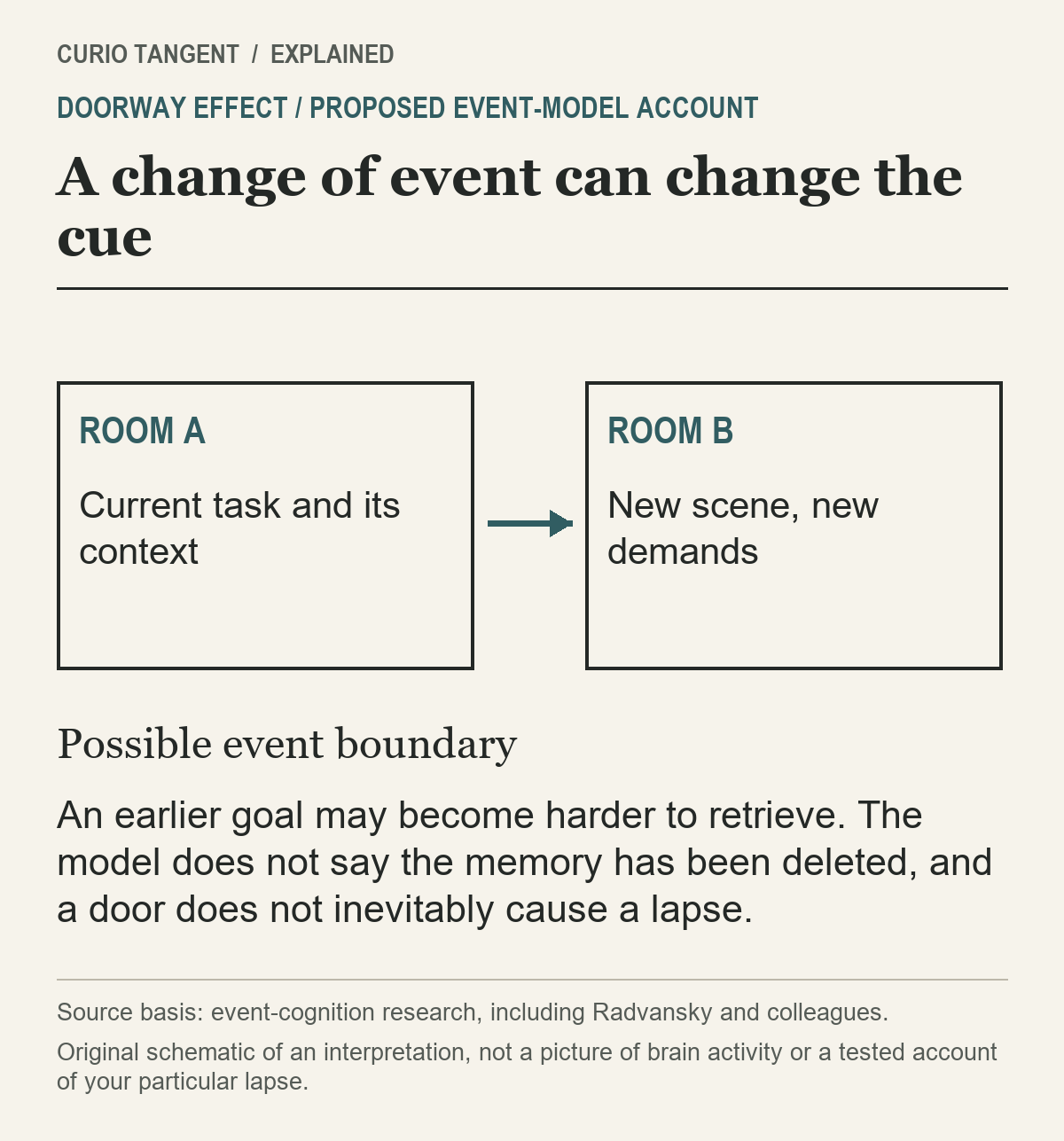
Think of an invented sequence: you decide to collect a charger, walk into a room and notice a message on another screen. Which part of that sequence mattered—the transition, the competing message, the strength of the original intention or a combination? The story alone cannot isolate those possibilities.
This is why “memory erased” is an unhelpful shortcut. It replaces a question about access and interference with a claim about destruction. The event-model account is an interpretation of memory processes, not evidence that a door operates like a delete key.
What the 2011 follow-up found
In a 2011 investigation, Gabriel Radvansky and colleagues observed location-updating effects with smaller-screen virtual environments and with actual rooms. Another experiment had people return to the room where objects were encoded; restoring that original context did not improve memory in that task.
That last result is easy to miss when reading a headline about rooms and memory. It means the paper does not supply a guaranteed “walk back and you will remember” trick. A specific proposal needs its own outcome, rather than being assumed from the general importance of context.
The researchers interpreted their results through an event-cognition model. That gives a framework for asking how information associated with different events competes at retrieval. It does not identify which process caused any particular lapse in a person’s day.
Why the 2021 results changed the conversation
McFadyen and colleagues’ 2021 study tested four variants involving virtual environments, video and real movement. It did not find the same significant doorway-related forgetting pattern. In one task with additional working-memory load, crossing a boundary instead increased false alarms to mismatched probes.
For an invented recognition example, a false alarm means answering “yes” to an object that was not the relevant one. A miss means failing to recognize one that was. Both lower accuracy, but they are different errors. The 2021 authors emphasized interference and questioned how broadly earlier findings generalize across task changes.
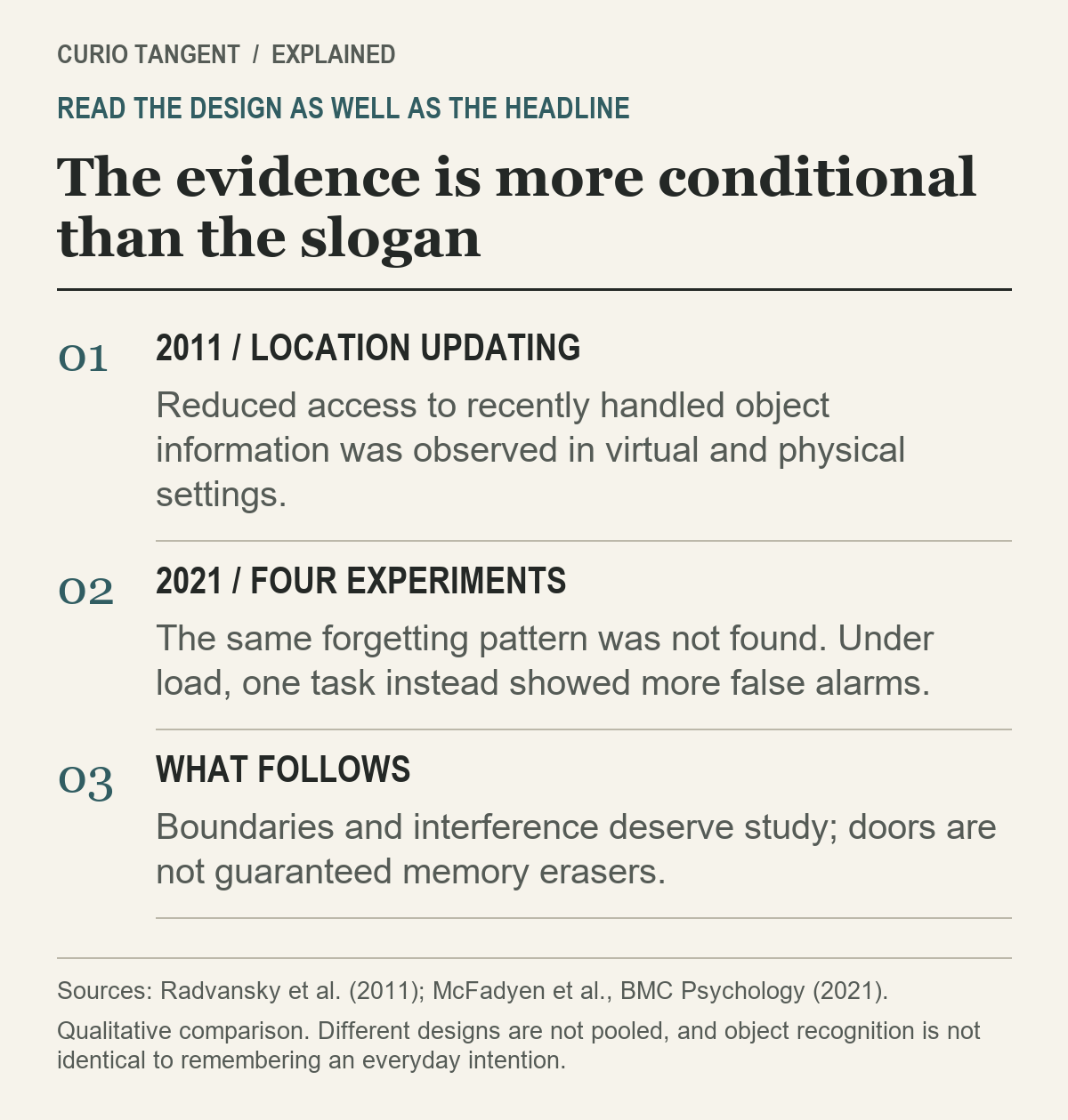
That is not a reason to discard the earlier work or declare that boundaries never matter. It is a reason to preserve the design details. A result can be meaningful within one set of conditions while remaining sensitive to how the next experiment is constructed.
What to do with the everyday frustration
A practical option is to make the intention available outside your head: write a short reminder, keep the relevant object visible or state the task before switching activities. Treat these as organizational ideas to try, not remedies proven by the doorway studies cited here.
For example, a note reading “charger from office” preserves a concrete action and destination. It is more specific than a vague plan to “get something.” Whether that helps you is a separate practical question from whether crossing a physical threshold changed performance in a laboratory task.
If you step back into the previous room, regard it as an attempt to recover a cue rather than a guaranteed reset. The research does not justify promising that a particular movement will restore a forgotten intention.
Continue the series with what aphantasia is and why déjà vu happens. All three topics become clearer when we separate an experience, a proposed explanation and the task used to test it.
Sources and method
Checked October 26, 2026, using the linked research. Publication years identify the studies; this is not a new-study announcement. Diagrams and everyday examples are original illustrations, not participant records. Prepared with AI assistance and source verification. We did not test memory, diagnose a condition or evaluate a treatment.