Guides / London & New York · Meeting planner
London to New York Time Converter: Meeting Planner
Use this London to New York time converter to choose a date, enter a local time and see the matching time in the other city. It works in both directions and checks the daylight-saving rules for the selected date, including the weeks when the gap changes.
CURIO TANGENT / MEETING DESK
Choose the date. Keep the right hour.
The calculator is loading. The example table below is always available.
Two cities, both directions. Results include the local date and UTC offset. Date and time inputs stay within this browser component.
How to use the London to New York time converter
Choose the city whose local time should stay fixed, then enter that city’s meeting date and time. Select Convert time. The result shows both local dates, the time-zone abbreviation and each UTC offset. The date field belongs to the source city, not necessarily the city where your device happens to be.
For example, if the organizer promises a 9 a.m. New York meeting, select New York as the source. If a London team instead promises 2 p.m. London time, select London. The same recurring appointment can shift on the other city’s clock when the countries change at different times.
The calculator accepts dates from 2020 through 2035 and uses the time-zone rules available in your browser. Future rules can change. For travel or a time-critical appointment, verify the date and named time zone with the organizer or operator as well.

Why London is not always five hours ahead
London and New York both move their clocks seasonally, but their transition dates do not line up. GOV.UK’s calendar lists the UK’s 2026 changes as March 29 and October 25. The US National Institute of Standards and Technology lists March 8 and November 1 for US places following the standard daylight-saving rule.
For much of the year, London is five hours ahead of New York. Between the mismatched spring changes and again between the autumn changes, the difference is four hours. The exact hour on a transition day matters, so a month-only lookup is less useful than converting a dated local time.
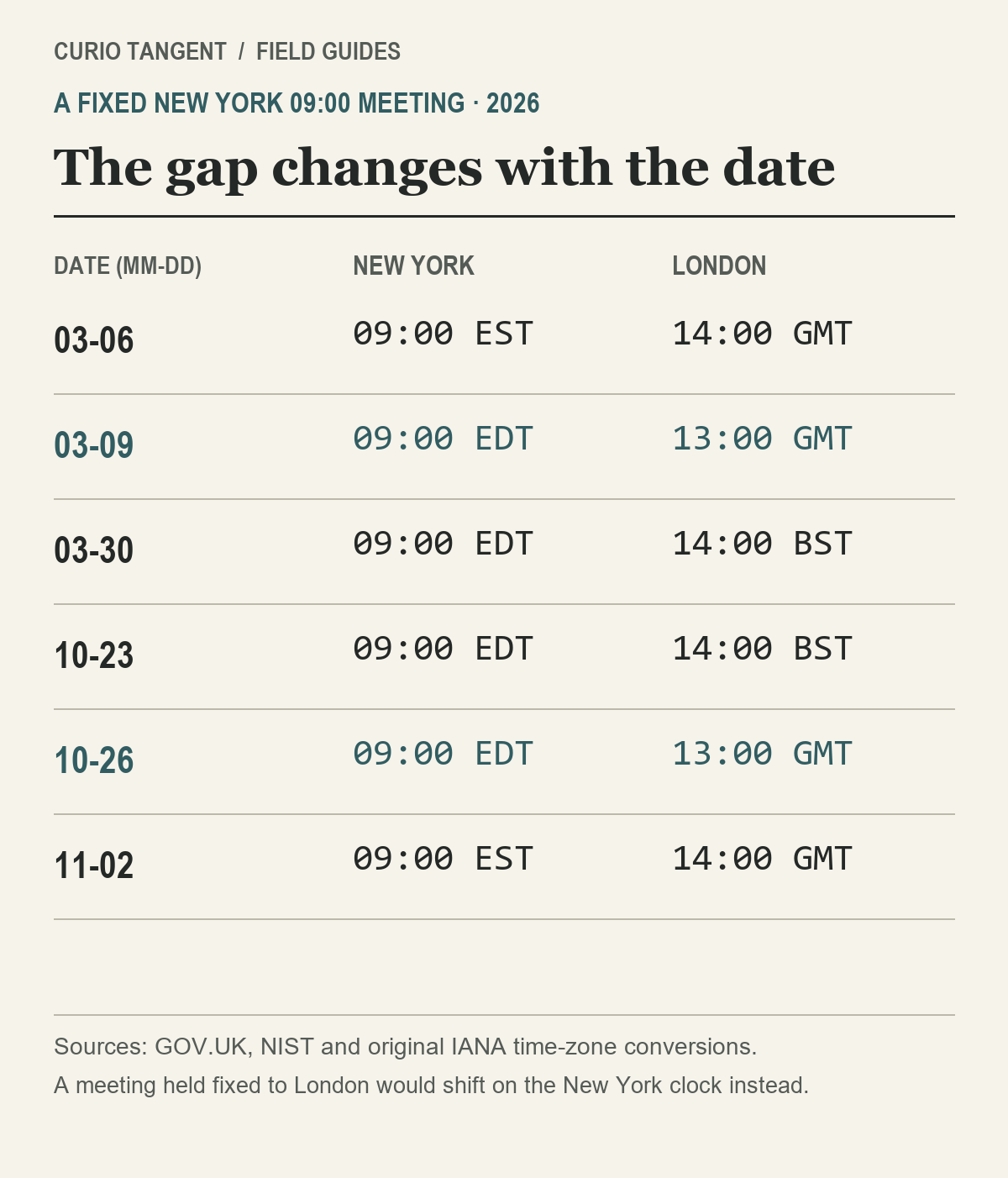
The examples below keep New York at 9 a.m.; they are conversions, not a prediction about a particular calendar app.
| Meeting date in 2026 | New York | London |
|---|---|---|
| March 6 | 09:00 EST | 14:00 GMT |
| March 9 | 09:00 EDT | 13:00 GMT |
| March 30 | 09:00 EDT | 14:00 BST |
| October 23 | 09:00 EDT | 14:00 BST |
| October 26 | 09:00 EDT | 13:00 GMT |
| November 2 | 09:00 EST | 14:00 GMT |
What happens when an hour occurs twice?
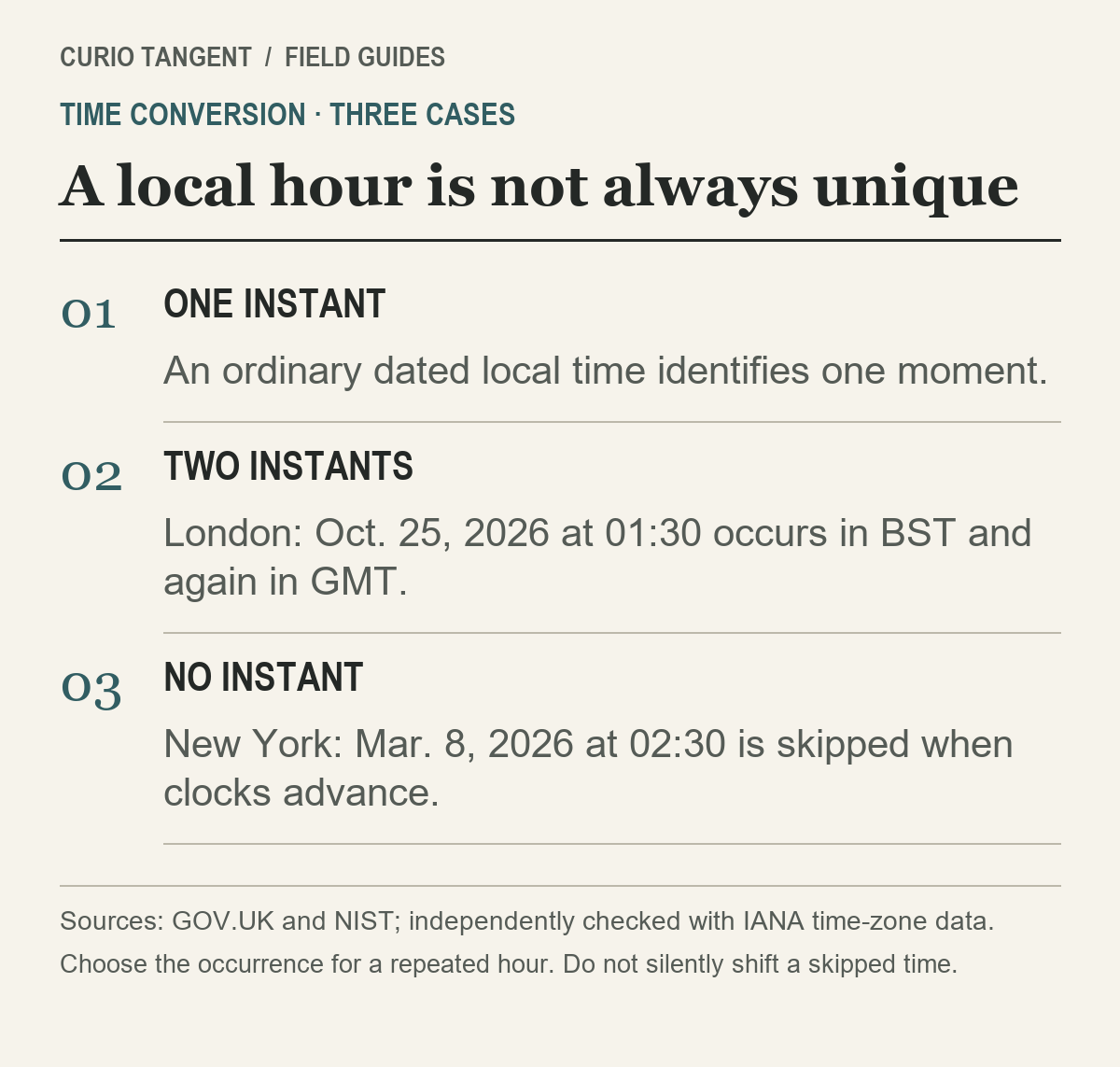
When clocks move backward, some local times identify two different instants. In London on October 25, 2026, 01:30 happens once in BST and once in GMT. The first is 00:30 UTC; the second is 01:30 UTC. In New York, the repeated hour occurs on November 1 instead.
The tool does not silently choose one occurrence. It asks you to select the first or second one and labels the UTC instant. If an invitation only says “1:30 a.m.” during that repeated hour, ask the organizer which occurrence they mean before treating a conversion as settled.
The reverse problem happens when clocks move forward. New York’s 02:30 on March 8, 2026 does not occur under the current rule: the clock jumps from the 2 a.m. boundary to 3 a.m. The calculator flags that skipped local time rather than moving the appointment to an unstated alternative.
A meeting checklist that survives a clock change
Put the full date, source city and local hour in the invitation. Use a named calendar zone such as Europe/London or America/New_York; avoid using “EST” as a year-round label for New York. The city observes EDT during its daylight-saving period.
Check the first meeting after each country’s transition. If the invitation’s time-zone field and the explanatory email disagree, clarify the intended anchor before editing a recurring series. A correct conversion cannot decide which side of the Atlantic the organizer meant to keep fixed.
The result may fall on the previous or next calendar date in the other city. Include that date when sharing an overnight appointment. Do not reuse New York’s answer for a different US city; this tool covers these two cities only.
For the current autumn schedule, our UK clock-change explainer walks through the October–November mismatch. If an AI assistant proposes a meeting time, the AI fact-checking guide explains how to verify a confident answer against its source.
Sources and method
Transition examples were checked against GOV.UK, NIST and independent calculations using the IANA time-zone database. The tool converts through UTC using the browser’s named time-zone support. Its date and time inputs are processed locally by this component and are not stored by the component. The displayed examples remain available if JavaScript is unavailable.
Prepared with AI assistance; the conversion logic was tested against independently generated time-zone cases, including repeated hours, skipped hours and date changes. Source checks: October 24, 2026.