Life / Mind Glitches 01 · Visual imagery
What Is Aphantasia? When the Mind’s Eye Does Not Make Pictures
What is aphantasia? It describes an absence or marked lack of voluntary visual imagery: trying to picture something without having the visual experience other people describe. Someone may know an apple’s shape and color, recognize one in front of them and discuss it perfectly well, yet not call up a picture of it at will.

That distinction is the starting point for Mind Glitches, our series about the gaps between an experience and the explanation we give it. “Picture an apple” sounds like one instruction. In practice, it can reveal that people use the word “picture” for surprisingly different inner experiences.
What is aphantasia—and what does the word leave out?
The University of Exeter’s review of a decade of research describes substantial variation in mental imagery. Aphantasia concerns voluntary visualization; it is not a label for having no thoughts, knowledge or ideas. The review also notes that people who cannot visualize at will can nevertheless dream visually.
That makes the timing and kind of experience important. Deliberately imagining an object while awake and encountering an image in a dream are different situations. A statement about one should not automatically become a statement about the other.
| Task | The useful question |
|---|---|
| Seeing | What appears while you look at the object? |
| Knowing | What facts can you say about it? |
| Visualizing | Is there a visual experience when you deliberately imagine it? |
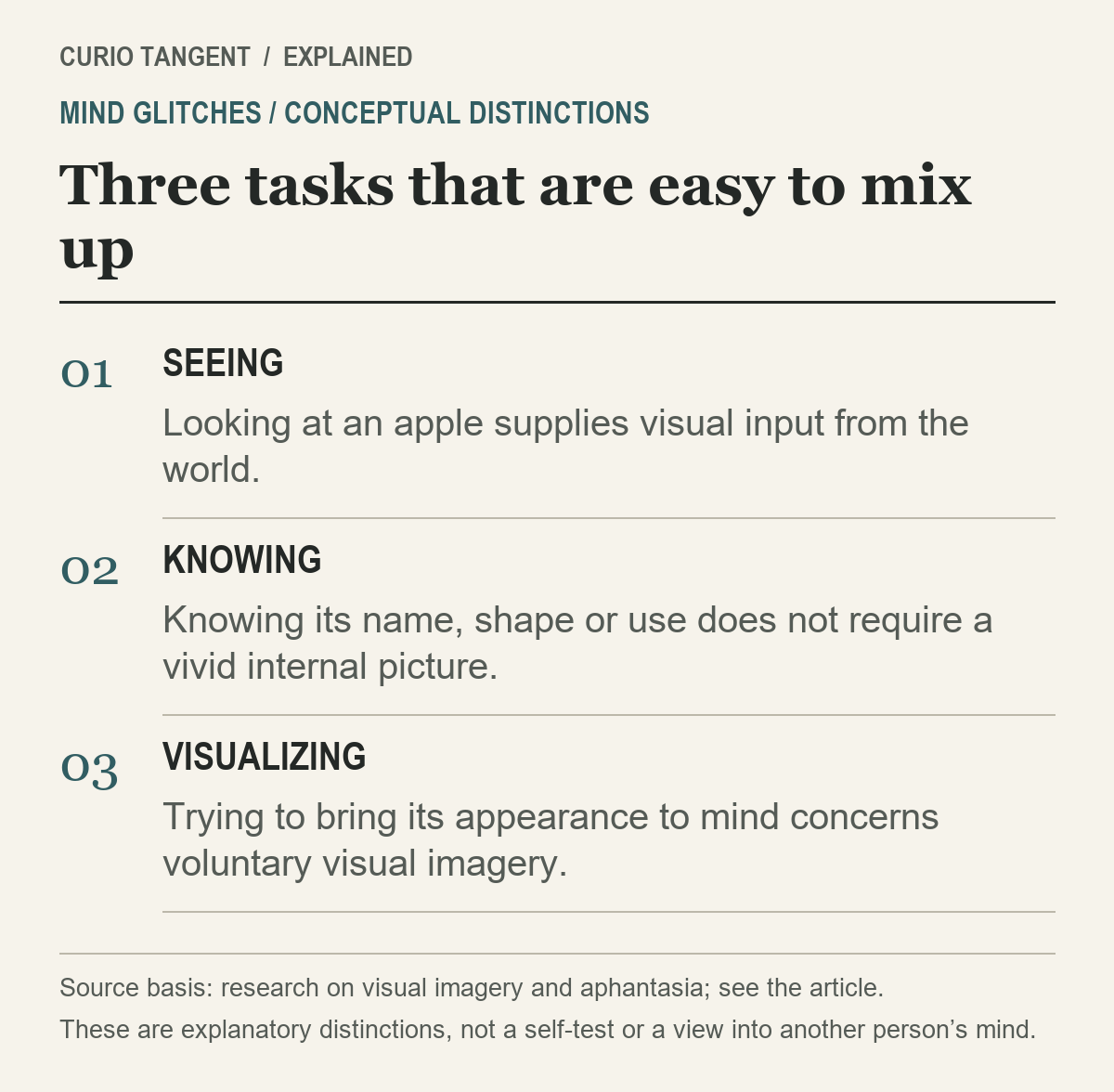
The table is a vocabulary aid, not a test. Describing an apple as red and round does not settle whether an internal image accompanied the answer. Equally, a faint image and no image are not necessarily the same report. Ask about the experience before interpreting the person’s ability.
Why an apple prompt cannot settle the question
Try this as a conversation starter: think of an apple, then describe what happened. Did you experience an appearance, think of words, retrieve facts or combine several approaches? There is no score attached to that question here.
A row of increasingly blurry apple pictures can suggest a vocabulary for vividness, but it cannot give direct access to another person’s mind. Looking at a printed picture is also different from generating imagery. Our apple photograph shows a real object; it does not show what an aphantasic person “sees inside.”
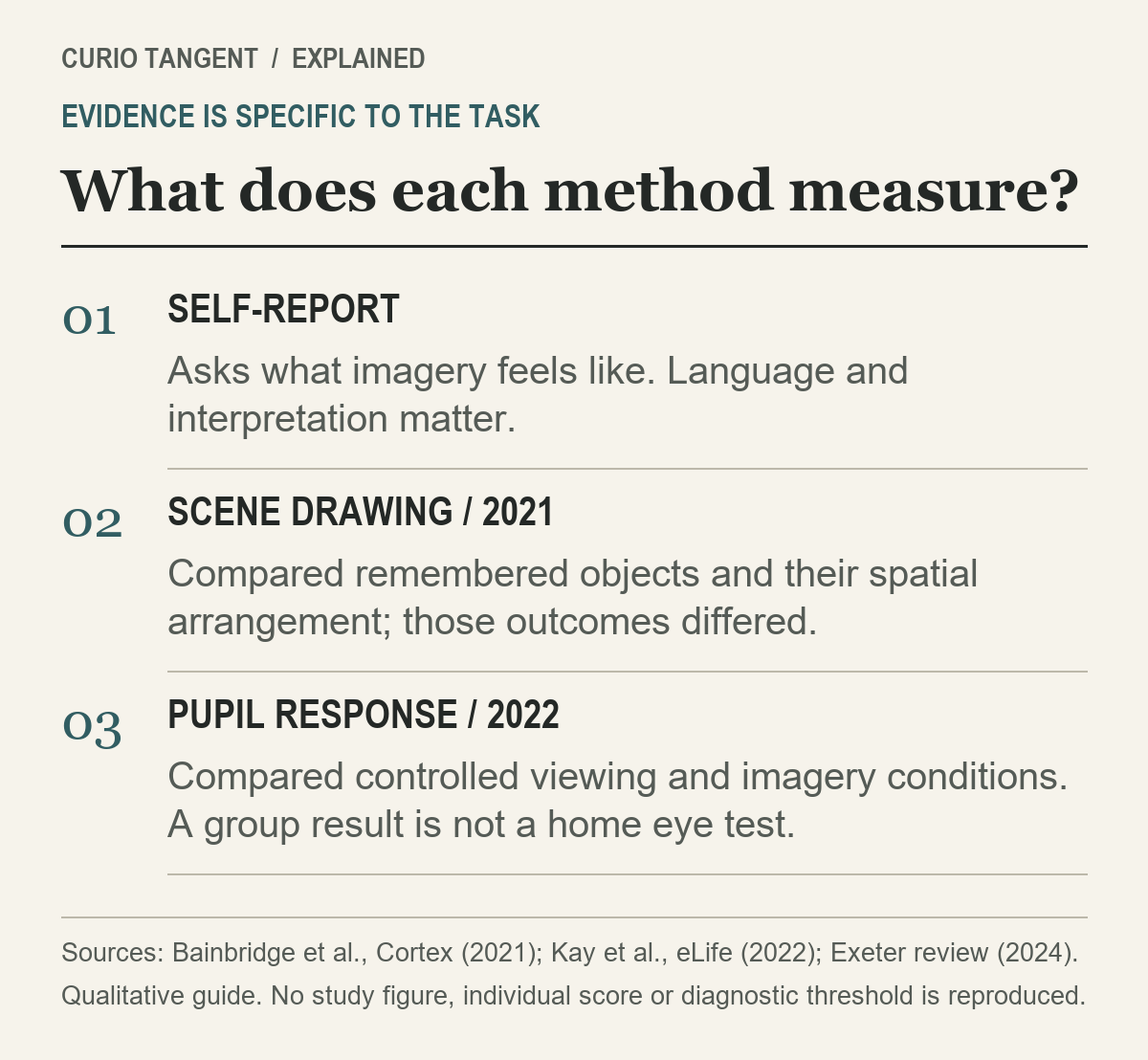
That is why research does more than circulate a picture and ask people to choose an answer. A useful account needs to explain what a particular measure captures, what comparison was made and which conclusion the result can support.
What drawings from memory can reveal
In a Cortex study published in 2021, Wilma Bainbridge and colleagues compared scene drawings made by people reporting aphantasia with those of participants with typical imagery. The aphantasia group remembered fewer objects and used less color, while the spatial placement of remembered objects remained comparably accurate. The study included 61 people with aphantasia.
The contrast matters more than the simple phrase “worse visual memory.” Remembering which objects were present and remembering where objects were arranged are separable outcomes. In that study, the differences appeared in memory drawing, rather than in the matched copying condition with the scene visible.
Imagine two descriptions of a room: one inventories the books, lamp and chair; another specifies the positions of a desk and window. This invented example is not a participant result. It illustrates why the amount of remembered detail and the organization of remembered space need separate questions.
Why researchers looked at pupils
A 2022 eLife study by Lachlan Kay and colleagues compared pupil responses while people viewed and imagined stimuli of different brightness. Participants with aphantasia showed responses to actual light and cognitive load, but the researchers found no significant evidence of the imagery-related light response in that group.
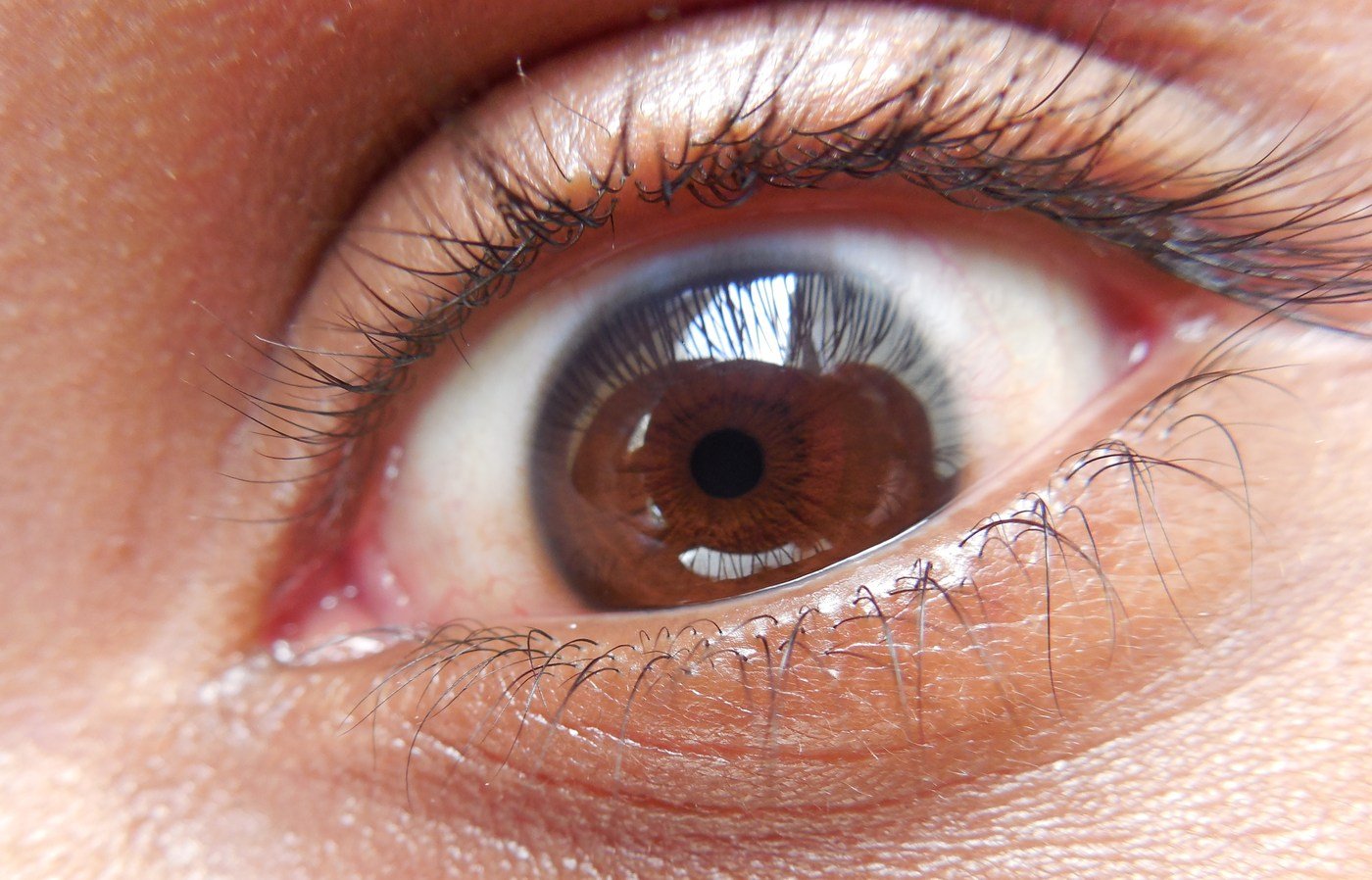
That supplied physiological evidence beyond a description of subjective experience. It did not turn an ordinary eye photograph into an aphantasia test. The authors identified limitations, including an aphantasia sample of 18 and groups that were not matched in age. Controlled conditions and group comparisons are central to interpreting the finding.
Do not try to infer your imagery from the apparent size of your pupil in a selfie. This article contains neither the measurement setup nor an individual diagnostic threshold. The photograph is simply an illustration of the body part the researchers measured.
A better way to talk about the mind’s eye
Instead of asking whether someone has an imagination, ask which task you mean. Can they describe a remembered scene? Locate objects within it? Deliberately experience an image? The answers need not form one single ranking from “good” to “bad.”
The evidence supports taking reported imagery differences seriously while avoiding a complete personality profile from one label. A drawing task is not an intelligence test, and a group result does not describe every individual’s strengths.
Continue Mind Glitches with why déjà vu happens and the doorway effect. Together, the three topics ask different questions about imagery, familiarity and retrieving a current goal.
Sources and method
Checked October 26, 2026. This explainer uses the linked research and university review; study dates are stated separately. Diagrams are original conceptual guides, not participant data or diagnostic tools. Prepared with AI assistance and source verification. We did not test participants or assess a reader’s imagery.