Money / United States · 2027 benefits planning
HSA Contribution Limits 2027: What to Set Aside Per Paycheck
The HSA contribution limits for 2027 increase to $4,500 for self-only coverage and $9,000 for family coverage, before any eligible catch-up amount. For open-enrollment planning, the next calculation is how much of that annual ceiling is already covered by your employer, rather than dividing the headline number straight across your paychecks.
The IRS set the 2027 figures in Revenue Procedure 2026-24, published in its June 15 bulletin. These are announced limits for the next calendar year, not an increase to what you can contribute for 2026. Your own allowable contribution still depends on eligibility and other circumstances.
HSA contribution limits: 2027 compared with 2026
| Coverage | 2026 base limit | 2027 base limit | Increase |
|---|---|---|---|
| Self-only | $4,400 | $4,500 | $100 |
| Family | $8,750 | $9,000 | $250 |
The earlier figures come from Revenue Procedure 2025-19. We also checked the published comparison against HSA Bank’s limits table. Its table separately lists a $1,000 catch-up for eligible people age 55 or older.
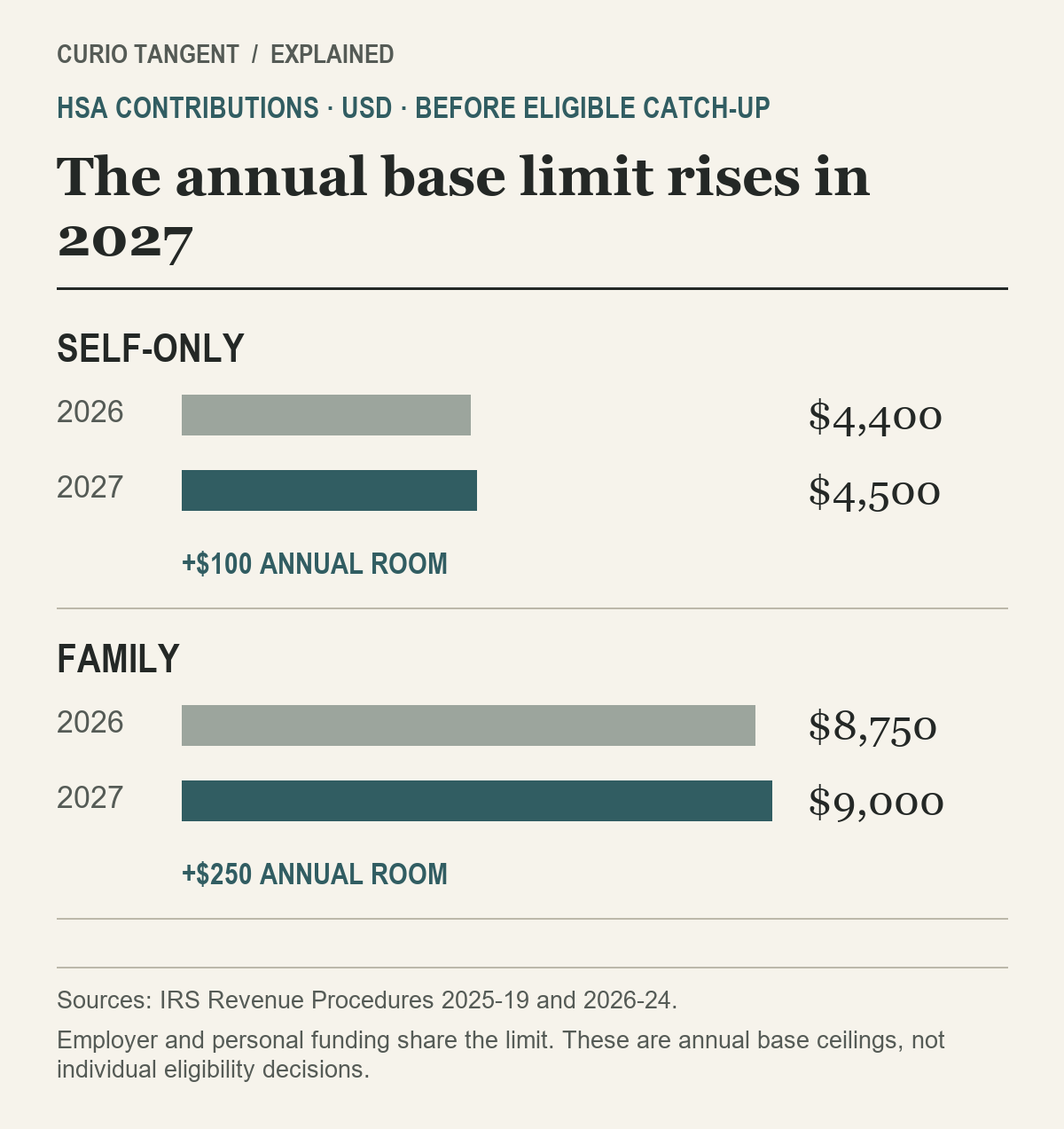
Treat the increase as extra contribution room, not cash the government puts into the account. A $100 higher ceiling means a fully eligible self-only saver can potentially contribute $100 more. It says nothing about whether an employer has increased its contribution or whether a household can comfortably afford a higher payroll election.
Employer funding shares the annual limit
An employer contribution is part of the limit. Fidelity’s HSA guidance explains the subtraction and the need to consider all contributions. For a simple full-year example without catch-up or other funding, use:
Personal contribution room = applicable annual limit − employer funding − other contributions for the year.
Ask benefits staff whether the quoted employer amount is guaranteed, conditional or paid in installments. Record the amount expected for the tax year you are planning. A number shown as an annual benefit and a deposit already received are different entries in a budget.
If you have contributed through another employer or another HSA, include that history in the discussion. Opening an additional account is not a reason to assume you have an additional annual ceiling. Keep one contribution worksheet across the accounts you use.

Three payroll examples, with rounding made visible
The following examples assume full-year 2027 eligibility, 26 paychecks, no catch-up and no other contributions. They are arithmetic illustrations, not instructions to elect the maximum or a determination of anyone’s eligibility.
| Example | Employer funding | Personal room | Illustrative payroll amount |
|---|---|---|---|
| Self-only | $600 | $3,900 | $150 × 26 |
| Family | $1,200 | $7,800 | $300 × 26 |
| Self-only | $0 | $4,500 | 25 × $173.08, then $173.00 |
For the third example, $4,500 divided by 26 is $173.076923… . Paying $173.08 on every check would total $4,500.08. Reducing the last illustrated payment to $173.00 makes the total exactly $4,500. Payroll systems may handle rounding differently, so confirm the actual election process rather than copying this schedule blindly.
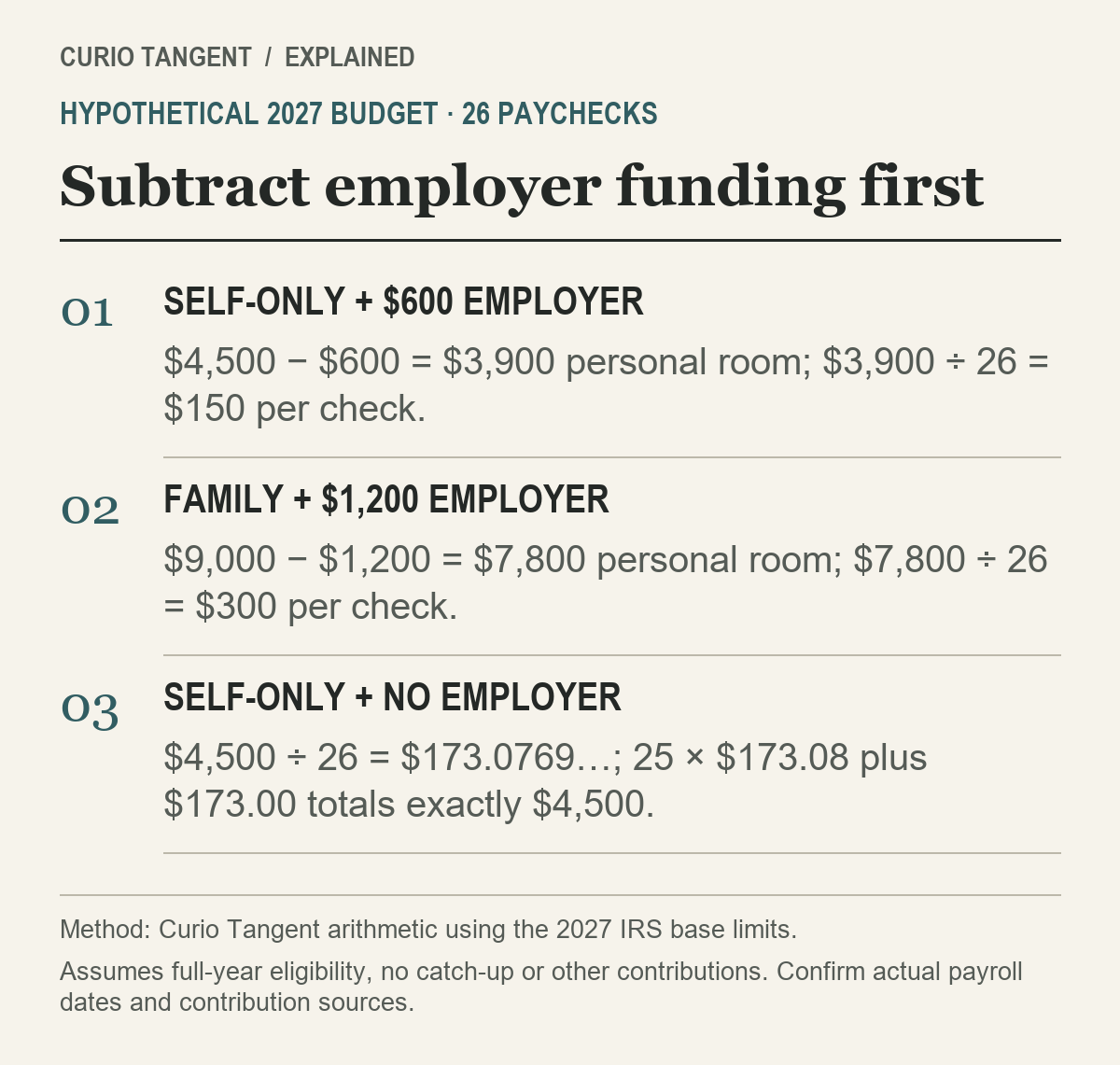
Use the actual number of remaining contribution opportunities. Twenty-six is an assumption here, not a universal payroll calendar. If an election begins after the first paycheck, divide the available room over the checks that remain and confirm when changes take effect. Recalculate when expected employer funding changes.
Check the plan and your eligibility separately
The IRS 2027 procedure PDF also lists the standard HDHP thresholds: minimum annual deductibles of $1,750 self-only and $3,500 family, and maximum out-of-pocket expenses of $8,700 and $17,400. These plan-design figures are not the HSA contribution limits.
Do not decide HSA compatibility from the deductible alone. The IRS’s current healthcare changes include special treatment for bronze and catastrophic plans starting in 2026. Ask whether the specific plan is HSA-compatible and whether your other coverage affects your ability to contribute.
For general contribution rules, Publication 969 discusses Medicare enrollment, other coverage, family arrangements and partial-year eligibility. The live edition checked for this article is labeled 2025, so its examples are not the source of our 2027 dollar amounts. If coverage changes during the year, do not assume the full annual ceiling automatically applies; ask for the appropriate calculation before increasing an election.
What to take into open enrollment
Bring the plan’s HSA-compatibility confirmation, coverage tier, expected employer contribution and payroll calendar. Then choose a contribution that fits both your applicable limit and your budget. The maximum is a ceiling, not a savings obligation.
Save a copy of the election and check the first affected pay statement against it. That turns the exercise into a reconciliation: the planned employee amount, the employer amount and what actually reached the account. Our Social Security COLA explainer discusses another 2027 budgeting change; the Thanksgiving service planner explains why a payment-system schedule does not establish a personal deposit date.
Sources and method
Checked October 25, 2026. Limits use the linked IRS procedures, with provider tables as a cross-check. All payroll examples are original calculations under the stated assumptions. Prepared with AI assistance and source verification. This is general planning information; no tax return, personal eligibility or payroll system was reviewed.