News & Trends / United States · November 1 clock change
Daylight Saving Time 2026: When US Clocks Go Back
For daylight saving time 2026 in most of the United States, the fall clock change is Sunday, November 1, at 2 a.m. local time. Clocks go back to 1 a.m., so the 1 a.m. hour happens twice. Hawaii and most of Arizona do not make this seasonal change.

The National Institute of Standards and Technology confirms the 2026 date and rollback rule. Timeanddate’s autumn report gives the same date. If you are arranging an overnight pickup, shift or reservation, the repeated hour matters more than the familiar phrase “fall back.”
Daylight saving time 2026: the quick US answer
| Question | Answer |
|---|---|
| When do most US clocks go back? | Sunday, November 1, 2026 |
| At what local time? | At 2 a.m., back to 1 a.m. |
| Do we gain or lose a clock hour? | The 1 a.m. hour repeats |
| Is it simultaneous across US time zones? | No; each observing area changes at its local time |
| Do Hawaii and most of Arizona change? | No |
The US Department of Transportation also lists American Samoa, Guam, the Northern Mariana Islands, Puerto Rico and the Virgin Islands among the places that do not observe DST. NIST identifies the Navajo Nation as an exception within Arizona: it does observe the seasonal change. For a location near a time-zone or jurisdiction boundary, check the exact place rather than applying a state-wide assumption.
Why 1:30 a.m. can mean two different moments
In New York, the first 1:30 a.m. on November 1 is in Eastern Daylight Time, or EDT. After the rollback, the second 1:30 a.m. is in Eastern Standard Time, or EST. The clock readings look identical, but the moments are an hour apart.
| New York local reading | Corresponding UTC time |
|---|---|
| First 1:30 a.m., EDT | 05:30 UTC |
| Second 1:30 a.m., EST | 06:30 UTC |
These conversions were calculated with IANA time-zone data. The example holds the city and date fixed; it does not suggest that “1:30 a.m.” everywhere in the US has the same UTC equivalent.

For an appointment inside that hour, ask which occurrence is intended and record the city with the time. A time-zone-aware calendar entry or a confirmed UTC offset can distinguish the two. A text message that says only “Sunday at 1:30” leaves the ambiguity unresolved.
The same issue can affect a duration calculation. A shift spanning the rollback may contain more elapsed time than subtracting its wall-clock start from its finish suggests. Use the employer’s schedule and applicable time records for a work shift; this article does not determine anyone’s pay.
Four cities, four different rollback instants
The following cities all follow the local 2 a.m. rule, but their rollbacks occur at different points on the UTC clock:
| City | UTC instant when the clock returns to 1 a.m. |
|---|---|
| New York | November 1, 06:00 UTC |
| Chicago | November 1, 07:00 UTC |
| Denver | November 1, 08:00 UTC |
| Los Angeles | November 1, 09:00 UTC |
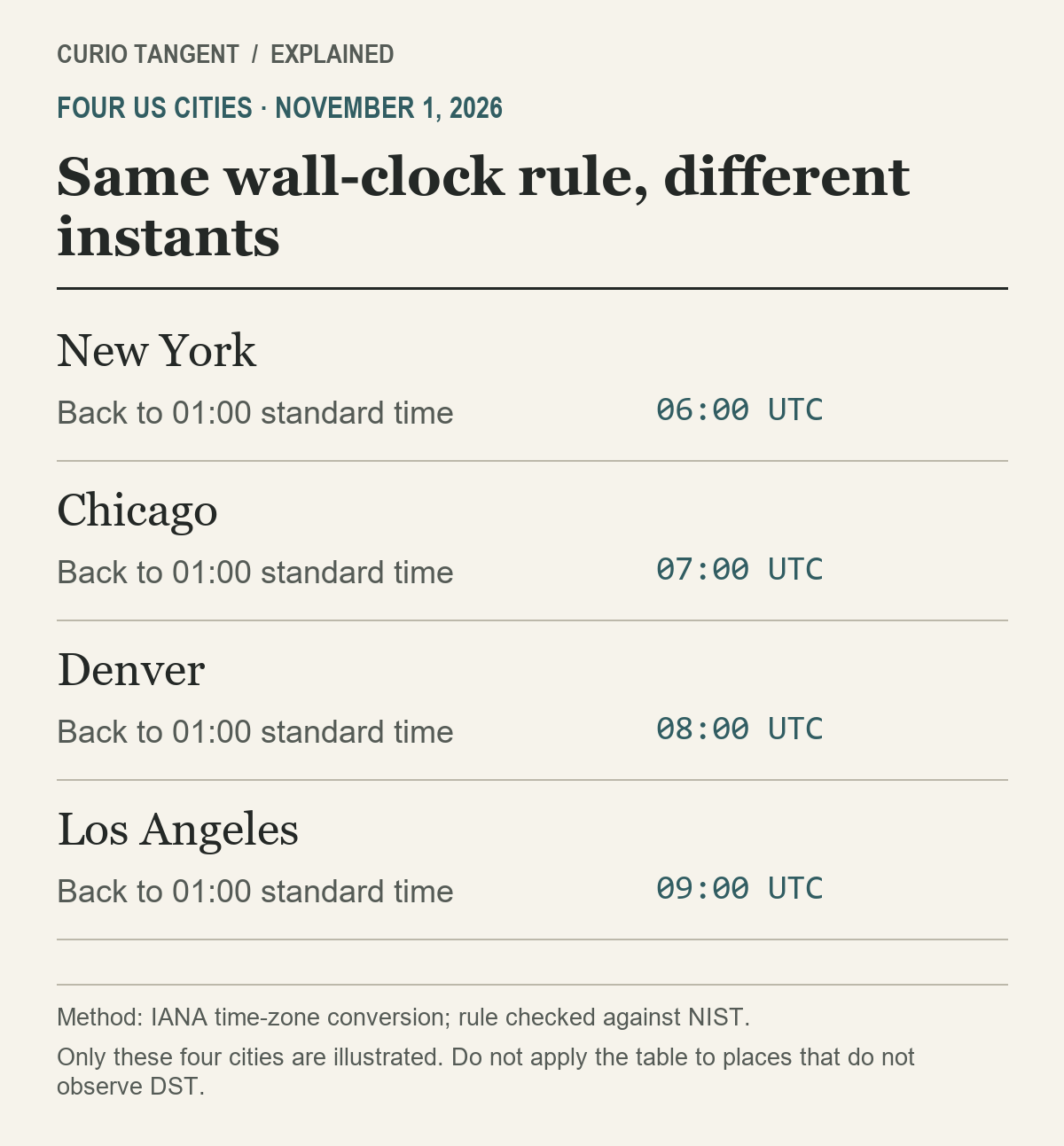
This is why a nationwide service or a conversation across time zones needs more than one announcement saying “the clocks change tonight.” Match the location and date first, then convert the specific event. The table covers these cities, not every part of their surrounding regions.
Check automatic clocks and manual clocks separately
A phone using automatic time settings may already have made the adjustment when you wake up. Check the displayed time and time-zone setting before changing it manually; turning an already-corrected clock back again creates a new error.
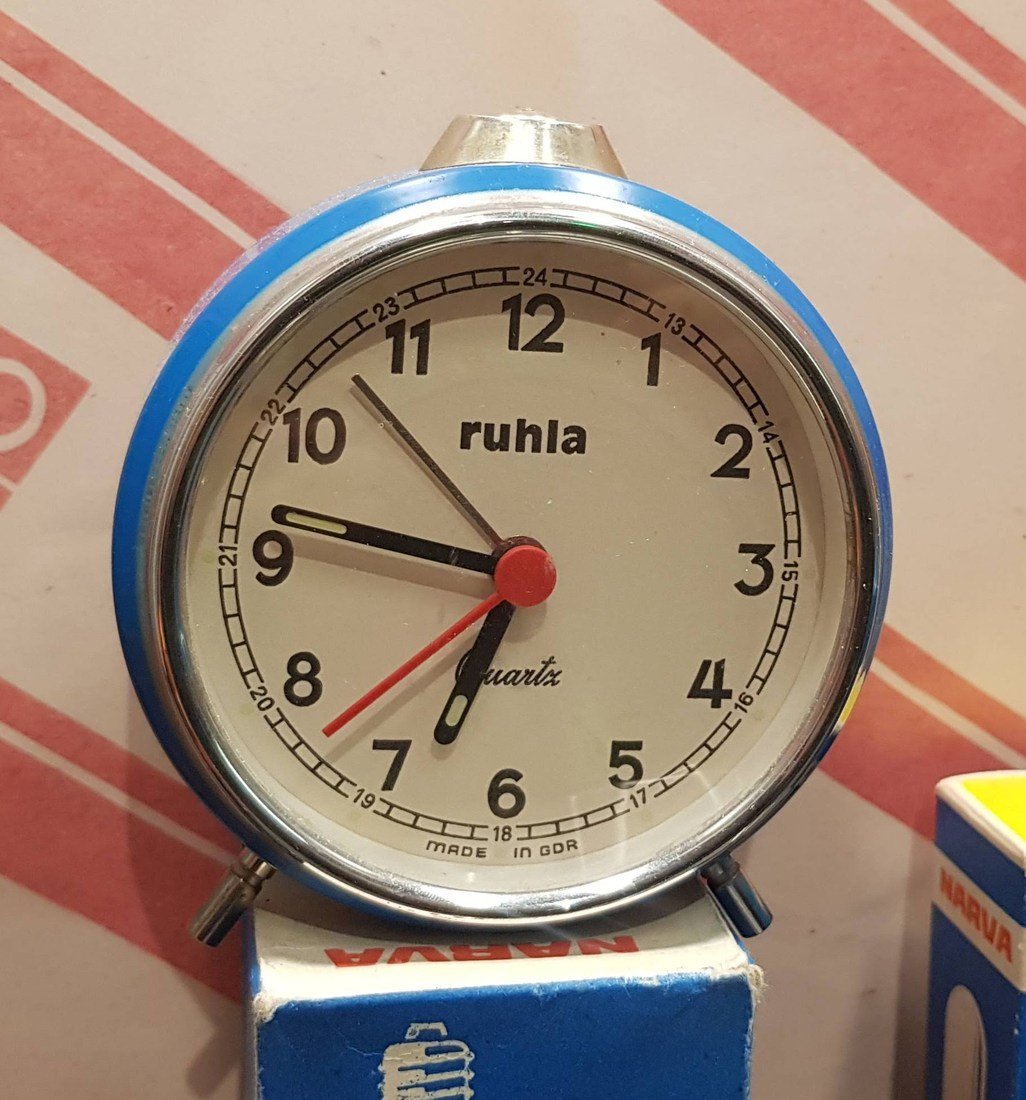
An analog alarm clock, wall clock or appliance clock may need its own adjustment. Check each device’s instructions and confirm the alarm afterward. The archive photograph below illustrates a manual-style clock; its pictured reading is not evidence of the 2026 transition.
For overnight travel, keep the departure and arrival times exactly as the operator confirms them, including the relevant local dates. If a booking falls inside the repeated hour, ask the operator to resolve the occurrence. A general time-change guide cannot settle a particular airline, rail or bus reservation.
Is this the last clock change?
The published 2026 calendar still includes November 1. A headline about a proposal does not, by itself, cancel that date. DOT’s uniform-time explanation describes the current framework: states can exempt themselves from DST, while observing states follow federally mandated start and end dates. States cannot independently choose permanent daylight time under that framework.
Under the current recurring rule, the next spring change is March 14, 2027. That date is a calendar calculation from the second-Sunday-in-March rule, not a guarantee about future legislation. Check the official schedule again when planning a future trip.
The UK has a different date
The UK goes back on October 25, 2026, according to GOV.UK. That is a week before the US date discussed here. Our UK clock-change article explains that event separately.
For a particular London–New York meeting, use the date-aware London to New York time converter. Keeping the date in the conversion avoids assuming the gap stays constant throughout the season.
Sources and method
Checked October 25, 2026. US dates and exceptions use NIST and DOT, with a separate Timeanddate cross-check. UK timing uses GOV.UK. City and repeated-hour examples were calculated with IANA time-zone data and checked against the official rule. Prepared with AI assistance and source verification. Photographs are archival illustrations; operator-specific travel arrangements should be confirmed with the operator.