News & Trends / Skywatching / October 26, 2026
Hunter’s Moon 2026: The Exact Time, Viewing Window and Supermoon Question
The Hunter’s Moon 2026 reached its full phase on October 26 at 04:12 UTC—just after midnight in New York, but still Sunday evening in Los Angeles. If you are deciding whether to look outside on Monday night, the useful distinction is between the exact astronomical instant and the much longer period when the Moon looks full.
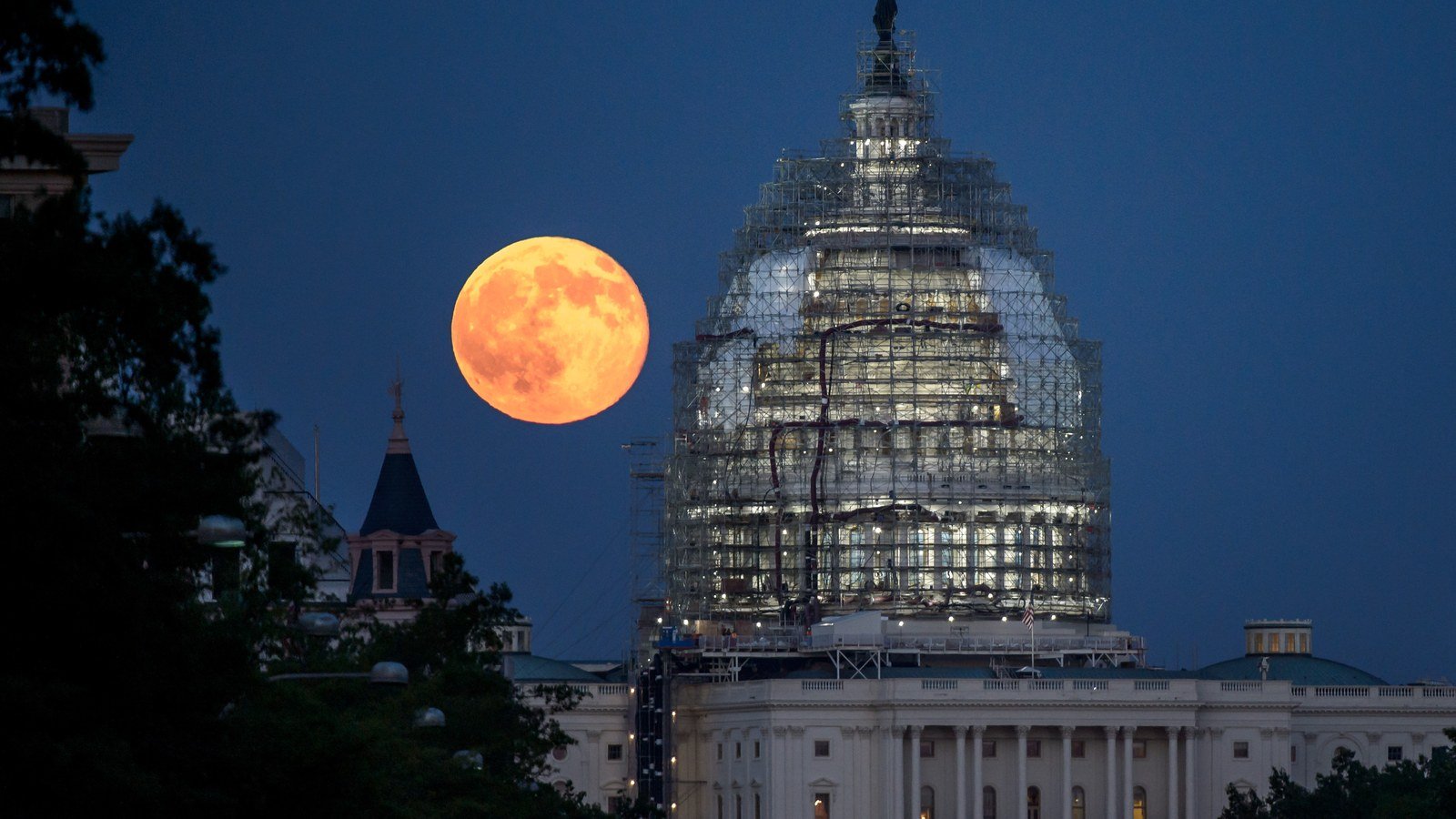
Coverage of the October 25–26 Moon is drawing attention to that date difference. Space.com’s current observing report identifies the same full-phase instant and explains the seasonal Hunter’s Moon name. Here is how to read the timetable without mistaking it for a local moonrise forecast.
Hunter’s Moon 2026: one instant, several calendar dates
NASA’s published phase table lists October 26, 04:12 Universal Time. The conversions below use that minute as 04:12 UTC for civil-time planning. They were calculated for each named city, including its daylight-saving status on that date.
| Location | Local instant of full phase |
|---|---|
| New York | Monday, October 26, 12:12 a.m. EDT |
| Chicago | Sunday, October 25, 11:12 p.m. CDT |
| Denver | Sunday, October 25, 10:12 p.m. MDT |
| Los Angeles | Sunday, October 25, 9:12 p.m. PDT |
| London | Monday, October 26, 4:12 a.m. GMT |
| Berlin | Monday, October 26, 5:12 a.m. CET |
| Seoul | Monday, October 26, 1:12 p.m. KST |
These entries describe the same event. London and Berlin have already moved off summer time; the listed US cities have not. Our US clock-change guide explains the separate November transition. Do not apply a November offset to an October photograph or observing appointment.
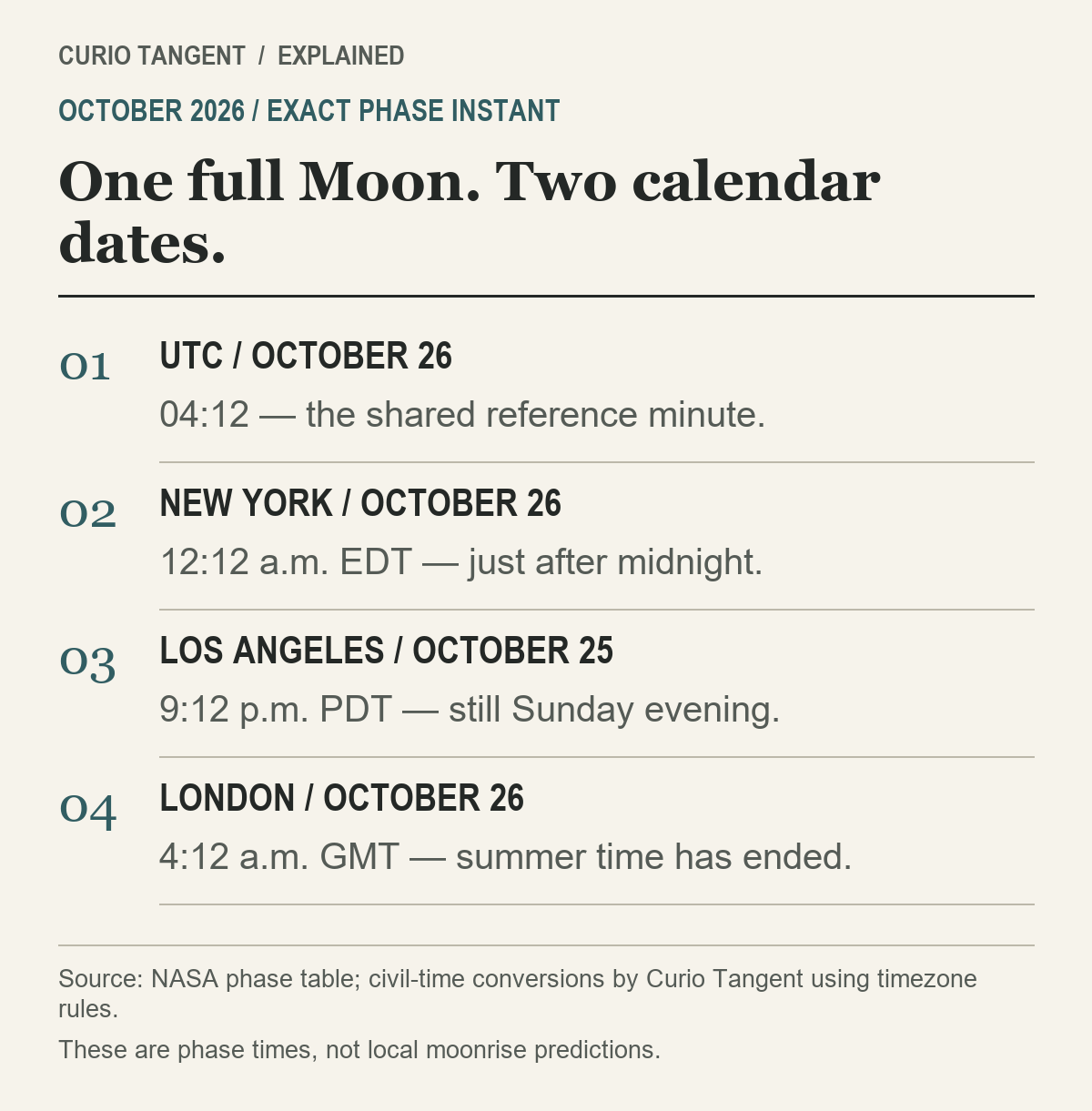
A calendar showing October 25 for the US West Coast and another showing October 26 for Europe can therefore both be correct. Before comparing two forecasts, check whether they give a phase instant, a date in UTC or a locally calculated rising time.
Monday evening is still an observing opportunity
According to NASA’s explanation of lunar phases, a full Moon is opposite the Sun in our sky, rises around sunset and sets around sunrise. It can appear full for a couple of days. That is why missing the exact minute does not mean missing the familiar bright, round appearance.
For readers checking this on October 26, the phase instant has already passed. Monday evening can still provide a nearly full view, subject to your location, horizon and weather. It is not necessary to set an alarm for the equivalent UTC minute just to enjoy the view.
Use a forecast for your actual observing location to find moonrise. The table above cannot tell you when the Moon clears a hill, building or cloud bank. A useful plan has two entries: the local rising time, then a separate note about the direction and openness of your view. The global phase calculation supplies neither of those local details.
Is this October full Moon a supermoon?
October’s event should not be described as a supermoon. NASA’s supermoon page lists the next ones on November 24 and December 24, 2026. Its explanation also makes clear that “supermoon” is an informal term associated with a full Moon near perigee, the close part of the Moon’s elliptical orbit.
That is a different question from whether a rising Moon looks enormous. “Full” describes the lighting geometry; “near perigee” describes orbital distance. A spectacular-looking horizon Moon does not establish the second condition.
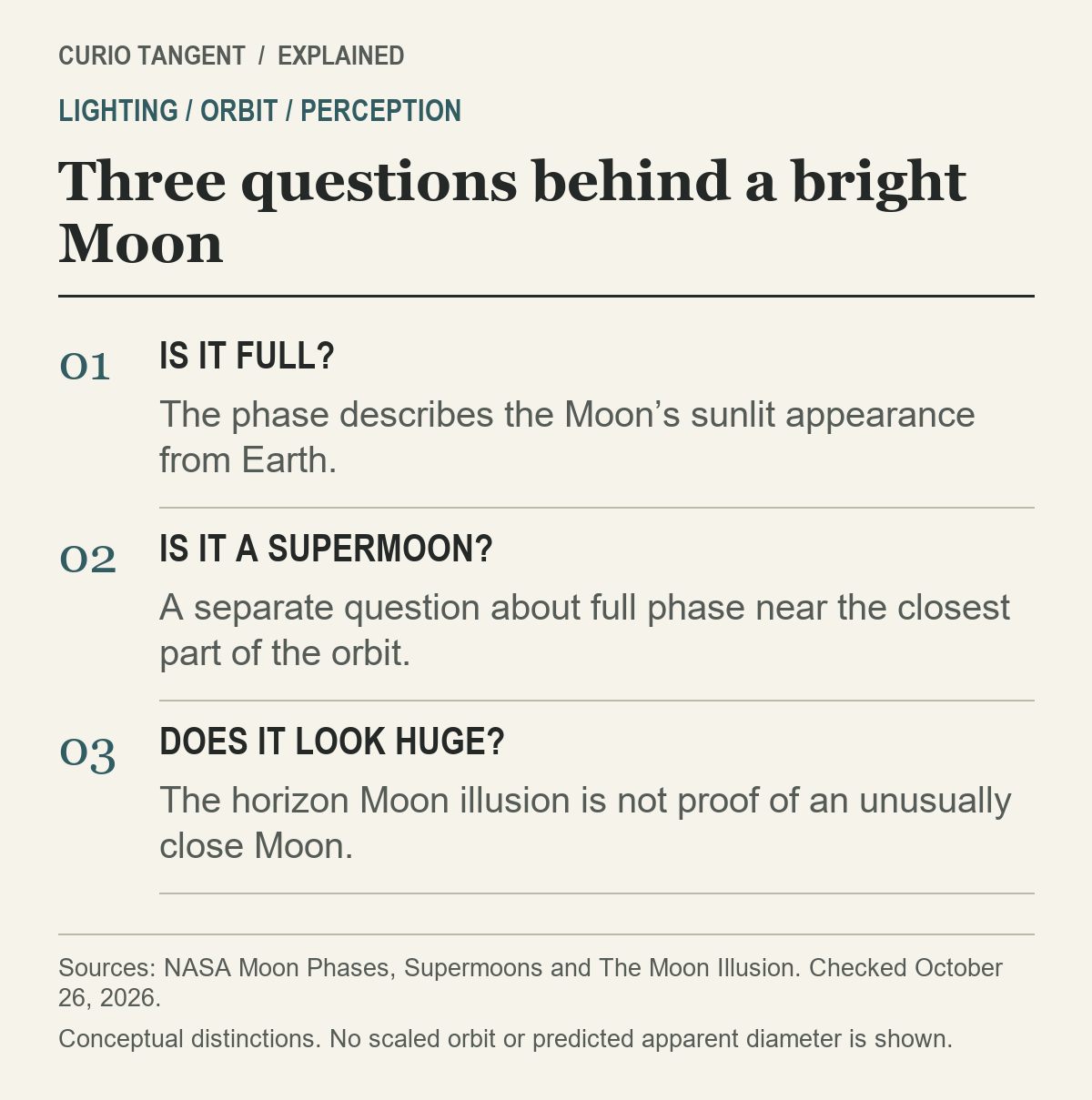
Treat the three labels in the diagram as separate checks, rather than a ladder of increasingly dramatic events. A full Moon does not need an additional supermoon label to be worth watching. This article does not promise an exceptional apparent diameter, a particular color or a clear sky for every reader.
Why it can look huge or orange near the horizon
NASA’s account of the Moon illusion distinguishes apparent bigness from a physical magnification by the atmosphere. The striking size impression is a perceptual effect; its complete explanation remains unsettled. A photograph made at unchanged zoom can help compare the Moon’s horizontal width at different heights.
Color is another matter. Moonlight passing through more atmosphere near the horizon can lose more shorter-wavelength light, leaving a warmer appearance. That does not make an orange Moon evidence of an eclipse. Keep the claim attached to the thing you observed: color, perceived size and orbital distance are different measurements.
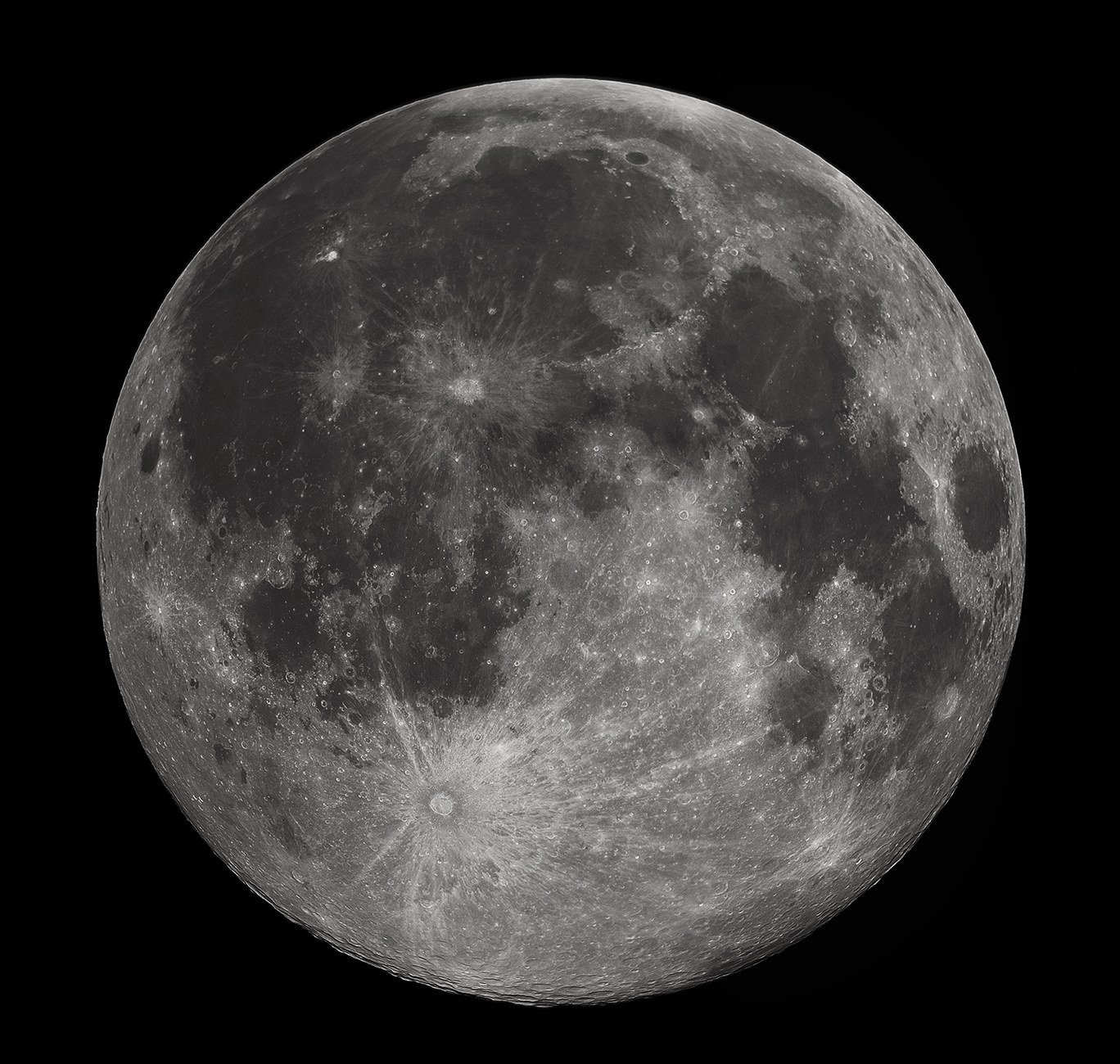
The archive image above is useful for looking at surface patterns, rather than forecasting tonight’s exact view. Its camera, stacked exposures and framing differ from an unaided glance. Neither photograph in this article was taken during the October 2026 event.
A simple photograph to bring home
NASA’s lunar photography guide recommends stabilizing a phone, focusing on the Moon, turning off the flash and reducing brightness so the disk does not become a featureless white patch. A timer can reduce movement when pressing the shutter.
Try a wide scene and a closer frame, keeping a note of which zoom setting you used. If you compare images later, compare the original framing as well as the cropped result. A dramatic crop and a wider landscape are different presentations, even when made from the same place.
For another story in today’s space coverage, see Europe’s astronaut-launch proposal. That is a decision about future transport; tonight’s Moon requires only a suitable view and a little attention to the clock.
Sources and method
Checked October 26, 2026, at 12:05 UTC. Phase data, orbital explanations and observing guidance were checked against the linked NASA pages; current reporting corroborates the date and public-interest context. City times were calculated with timezone rules. Photographs are dated archive material and diagrams are original explanatory work. Prepared with AI assistance and source verification; no on-location observing or weather forecast is claimed.