Guides / US flights · Battery packing guide
Power Bank on a Plane: 20,000mAh and the 100Wh Rule
Taking a power bank on a plane starts with two checks: its watt-hour rating and the operating airline’s policy. A hypothetical 20,000mAh battery at 3.7V is 74Wh, but “20,000mAh” alone is not a boarding approval. Power banks belong in carry-on baggage, and an airline can impose tighter limits than the federal baseline.

The FAA battery guide treats power banks as spare lithium-ion batteries. This article explains that US framework, then compares it with American Airlines’ specific portable-charger policy. It is not a universal rulebook for every international route.
Power bank on a plane: check the Wh label first
The FAA’s ordinary lithium-ion limit is 100Wh per battery. Its guidance allows certain larger spare batteries up to 160Wh with airline approval and quantity restrictions. That allowance does not override an airline’s more restrictive power-bank policy.
Look for the manufacturer’s printed Wh rating. If you need to interpret a capacity expressed in mAh, the calculation is:
Watt-hours = milliamp-hours × nominal battery voltage ÷ 1,000.
| Hypothetical capacity | Nominal battery voltage | Calculated energy |
|---|---|---|
| 10,000mAh | 3.7V | 37Wh |
| 20,000mAh | 3.7V | 74Wh |
| 27,000mAh | 3.7V | 99.9Wh |
| 27,000mAh | 3.85V | 103.95Wh |
| 30,000mAh | 3.7V | 111Wh |

The two 27,000mAh rows explain why a capacity number by itself is insufficient. Changing the assumed nominal voltage changes the energy calculation and can move the example above 100Wh. These are illustrations, not measurements of products for sale.
Use matching manufacturer specifications rather than substituting a USB output voltage. A 5V, 9V or 20V charging-output label answers a different question. So does a “100W” charging-power claim: watts and watt-hours are different quantities. If the rating is missing or unclear, confirm it with the manufacturer and airline before packing.
American Airlines has a specific power-bank limit
American’s restricted-items page currently has a separate section for portable chargers. It limits passengers to two power banks, each no more than 100Wh, in carry-on baggage. Do not substitute the page’s general spare-battery section for that more specific instruction.
The carrier also says to keep power banks accessible and visible while in use, such as in an under-seat personal item or seatback pocket. It prohibits storing them in overhead bins or other enclosed spaces and recharging the power bank from an in-seat outlet.

That distinction changes the answer for a 111Wh example. The FAA’s larger-spare-battery framework is not permission to take that power bank on American under its published 100Wh portable-charger cap. Ask the airline about your actual device rather than arriving with only a general regulatory table.
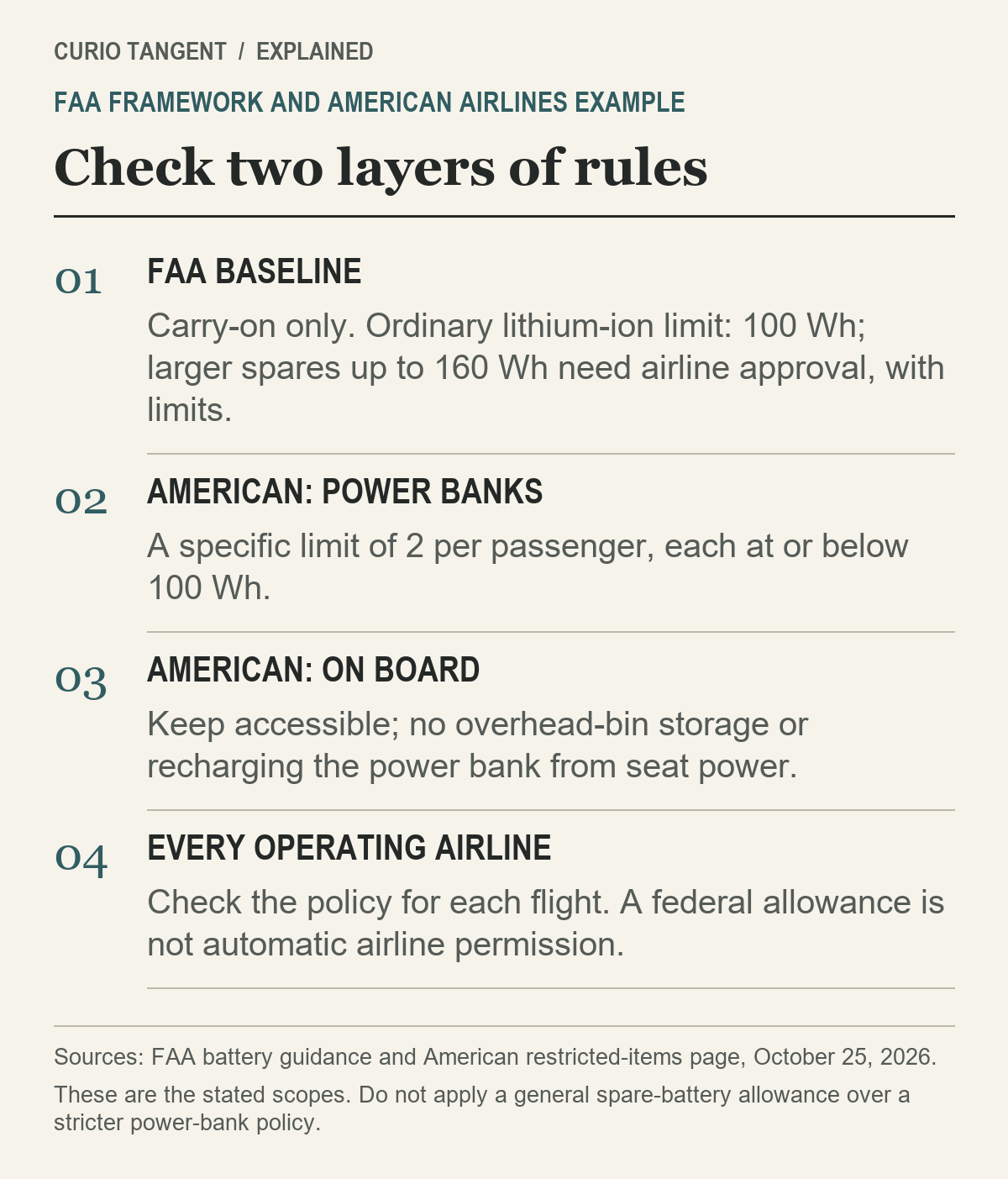
For a connection, identify the operating carrier on each segment. A marketing airline name or one checked policy is not enough to establish the requirements for a flight operated by a different airline. Recheck the carrier’s current page close to departure.
What if the carry-on bag is taken at the gate?
The FAA says spare lithium batteries, including power banks, cannot go in checked baggage. If an airline takes your cabin bag for checking, remove the power bank before handing over the bag and tell the crew if you need help finding an acceptable place to keep it.
Pack it so you can reach it without emptying the whole suitcase. The useful preparation is knowing where it is, not simply remembering that it was placed in a carry-on at home. Follow the crew’s instructions if the packing arrangement changes during boarding.
Protect the battery and check its condition
FAA lithium-battery packing guidance requires protection against damage and short circuit. It lists protective packaging, cases or pouches among suitable approaches, depending on the battery. Keep exposed terminals away from loose metal items.
The same guidance excludes damaged or recalled batteries likely to produce dangerous heat or sparks unless the battery has been removed or otherwise made safe under the applicable rules. For an ordinary traveler, a swollen, damaged or recalled power bank is a reason to stop and ask the manufacturer or airline—not to improvise a repair before departure. Check the exact model against the manufacturer’s recall information.
This guide does not cover the separate exceptions for mobility devices. Those arrangements need the airline’s dedicated assistance guidance rather than a consumer-power-bank table.
A short packing check
- Read the printed Wh rating and identify the exact model.
- Check quantity, capacity, stowage and use rules for every operating airline.
- Keep the device protected and accessible in cabin baggage.
- Remove it if that bag is checked at the gate, and follow crew instructions.
Our USB-C charging guide explains the separate issue of charger output and cable capability. For international documents, see the US online passport renewal guide.
Sources and method
Checked October 25, 2026. Rules are attributed to the FAA and American Airlines within their stated scopes. Energy values are Curio Tangent calculations using hypothetical nominal voltages. Prepared with AI assistance and source verification. No battery was tested, no airline approval was obtained and the photographs do not certify a device for travel.